
East Lyme & Niantic, Connecticut
Exterior Solar Shades in East Lyme, CT
Block the heat and glare off Niantic Bay before it ever reaches your glass — without giving up the view. Custom-measured, custom-fabricated, and installed by Shoreline Shade.
Or call us directly: (860) 510-3862
What the East Lyme sun actually does to a home
East Lyme sits right on Niantic Bay, and that changes the math on solar heat. The sun comes at you from the sky and off the water at the same time. UV bounces up from the surface of the Sound and hits elevations that would be shaded anywhere inland. By midday a west-facing slider or a three-season sun room can become genuinely uncomfortable — not warm, but unusable.
Interior blinds slow that heat down, but they also close off the view, which defeats the entire point of owning a coastal property. Pull the shades to cool the room and you have traded away the reason you bought the house.
Exterior solar shades solve the problem at a different point in the sequence. They intercept solar energy before it passes through the glass. A fabric rated at 10% openness blocks roughly 90% of solar heat gain while still letting you see straight through to the yard and the water. Close the shade, keep the view, and drop the interior temperature by 10 to 15 degrees.
For homeowners along Niantic Beach Road, Crescent Beach, Black Point, Giants Neck, or anywhere near Rocky Neck State Park, that trade-off is usually an obvious one. Shoreline Shade serves East Lyme from our base in Clinton — less than 20 minutes up the shoreline. We know these exposures, these architectural styles, and what the salt air does to hardware over a decade.
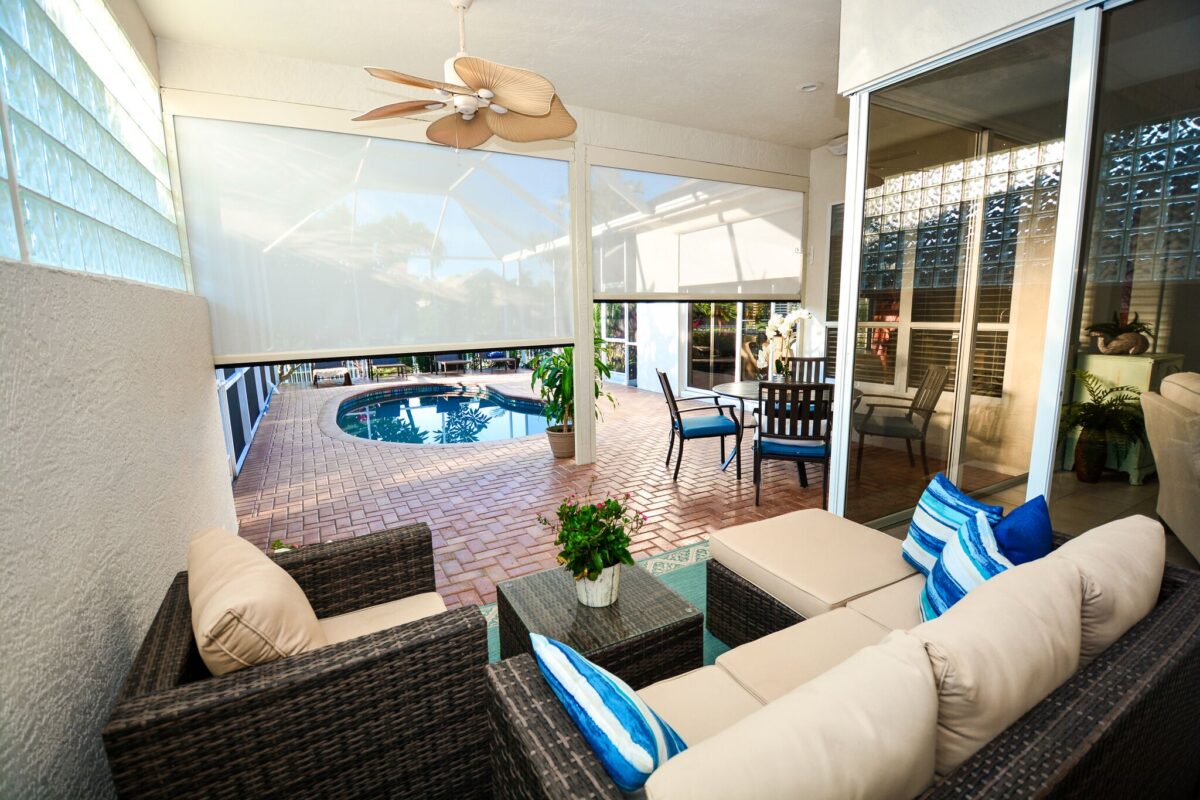
Exterior solar shades stop solar heat at the outside of the glass, so the cooling load never enters the room.
Why exterior beats interior every time
An interior shade stops the light. An exterior shade stops the heat. That distinction matters more than most homeowners realize, and it is the single most useful thing to understand before you spend money on either one.
Heat blocked before it enters
By the time sunlight passes through glass it has already converted to heat inside your home. An exterior shade intercepts that solar energy first, reducing cooling load at the source rather than managing the result.
UV protection for interiors
Even a 10% openness fabric blocks nearly all UV radiation. Hardwood floors, area rugs, upholstered furniture, and artwork along east and south exposures last significantly longer when shaded from direct sun.
The view stays open
Solar shade fabric is engineered to be see-through from the inside while dramatically reducing glare. You keep the Niantic Bay vista; the glare and the heat are what disappear.
Lower energy bills June–September
Shading glass on a south or west exposure is one of the highest-return summer comfort improvements available to a coastal home. Less heat in means the air conditioning cycles less often, period.
| Exterior solar shade | Interior blind or shade | |
|---|---|---|
| Where heat is stopped | Outside the glass, before conversion | Inside the room, after conversion |
| View retained | Yes — see-through fabric | Usually no — must close to block heat |
| Effect on cooling load | Large reduction at the source | Modest — heat is already indoors |
| Glare control | Excellent | Good, but at the cost of the view |
| Weather exposure | Built for it — marine-grade materials | Not applicable |
Not sure whether shades, screens, or an awning is the right answer for your exposure? Our exterior and motorized shade options and retractable screen systems solve overlapping problems in different ways, and we will tell you honestly which one fits your opening.
Understanding openness ratings (the number that matters most)
Every solar shade fabric carries an openness percentage. It describes how much of the weave is open space rather than yarn, and it is the primary lever controlling the balance between heat rejection and visibility. Lower numbers block more; higher numbers see through better.
| Openness | Approx. solar heat blocked | Best suited to |
|---|---|---|
| 1% | ~97% | Severe west glare, media rooms, near-blackout privacy |
| 3% | ~95% | Harsh afternoon exposures where comfort outranks view |
| 5% | ~92% | The common shoreline choice — strong heat control, good view |
| 10% | ~90% | View-first installations facing the water |
| 14% | ~85% | North and east exposures, shaded porches, maximum visibility |
Fabric colour matters too, and it works in the opposite direction from intuition. Dark fabrics absorb light and deliver noticeably better outward visibility and glare control. Light fabrics reflect more solar energy and keep the shade itself cooler, but they scatter light and can wash out the view. Most East Lyme homeowners land on a 5% or 10% openness in a bronze, charcoal, or neutral tone that reads cleanly from the water side of the property.
The U.S. Department of Energy’s guidance on energy-efficient window treatments covers the underlying physics of solar heat gain in more detail if you want the background reading before your estimate.
Motorized or manual — both are built for the shoreline
Motorized solar shades
A motorized shade rolls up and down with a remote, a wall switch, or a smartphone app. Pair it with a sun sensor and the shade manages itself, deploying when the sun hits the glass and retracting when clouds move through or the light angle shifts. For vacation homes and properties that sit empty midweek, that automation means the interior stays protected even when nobody is there to think about it.
We offer both battery-powered and hardwired motors. Battery motors eliminate any wiring in finished trim and recharge over USB, which makes them the practical retrofit choice on a finished home. Hardwired motors are the right call for permanent, daily-use installations on year-round residences, and they integrate cleanly with home automation platforms — the same approach we cover in our guide to smart home shade and awning integration.
Manual solar shades
A spring-loaded or crank-operated manual shade costs less and lasts just as long as a motorized unit. For a screened porch, a covered deck, or a fixed pergola where the shade sits deployed most of the season anyway, manual operation is often the smarter purchase — there is simply less to service over twenty years.
We install manual shades on tracks, side channels, or zip-guided systems that keep the fabric taut in the breezes that come off the Sound. A flapping, loose shade defeats the entire purpose and wears the fabric prematurely. Our installations are built to stay exactly where you put them.
Hardware and fabric built for salt air
East Lyme is a coastal environment, and coastal environments are unforgiving to outdoor hardware. Salt-laden air accelerates corrosion on fasteners, brackets, and motor housings in ways that inland installations never contend with. Specifying the wrong metal on a Black Point installation shows up as staining and seizing within a few seasons.
Powder-coated aluminum
Aluminum housings and tubes with a quality powder-coat finish are the correct specification within a mile of the water. Aluminum does not develop the red corrosion that steel does in salt air.
Stainless fasteners
Mounting hardware and screws should be stainless steel, not zinc-plated. This is a small line item that determines whether the installation still looks right in year eight.
Marine-grade fabric
Solution-dyed acrylic and PVC-coated polyester mesh resist UV degradation, mildew, and salt exposure. Colour holds rather than chalking out on the exposed side.
Sealed motor housings
Any outdoor motor should carry an IP44 rating or better for moisture resistance, and be positioned so wind-driven rain is not landing directly on it.
The same principles govern fabric care once the shades are up. Our post on Sunbrella fabric care and maintenance for Connecticut homeowners covers seasonal cleaning and what to do about the green film that shows up on shaded north elevations.
What exterior solar shades cost in East Lyme
We do not quote exterior shades over the phone, because the number depends on things we have to see — opening dimensions, mounting surface, whether there is a soffit to work with, and how the electrical would run. What we can give you is an honest budgeting framework so you know whether this project is in your range before we visit.
| Scope | Manual | Motorized |
|---|---|---|
| Single window or door (up to 6 ft) | $700–$1,400 | $1,200–$2,400 |
| Large slider or bay (8–12 ft) | $1,400–$2,600 | $2,300–$4,200 |
| Covered porch bay (12–16 ft) | $2,200–$3,800 | $3,400–$6,000 |
| Multi-bay porch or sun room (3–5 openings) | $5,000–$11,000 | $8,000–$18,000+ |
Costs move with a handful of specific variables: total width and drop, whether side channels or zip tracks are required to handle wind, motor type and control scheme, fabric grade, and mounting complexity. Cedar shingle, stucco, and masonry all take longer than a straightforward fascia mount. Sensor automation and smart-home integration typically add $200 to $600 per opening.
If you are weighing shades against other shading approaches, our breakdown of retractable awning costs in Connecticut and our comparison of motorized screens versus retractable awnings put the numbers side by side.
How the East Lyme process works
Four steps, one crew, no sales handoffs.
On-site measurement visit
We come to you, measure every opening, assess the mounting surface and architectural details, and confirm your exposure and primary shade angles. Usually 30 to 45 minutes for a single property.
Fabric and hardware selection
We show you openness ratings, colour options, and motor choices matched to the property’s style and how you actually use the space — not a catalogue dump.
Custom fabrication
Every shade is cut to the exact dimensions of your opening. There are no standard sizes. Hardware is selected for your specific mounting surface so the bracket is right the first time.
Professional installation
Our crew handles it start to finish. We test operation, align tracking, confirm motorisation, and walk you through every control before we leave. The site is left clean.
Our work along the Connecticut shoreline
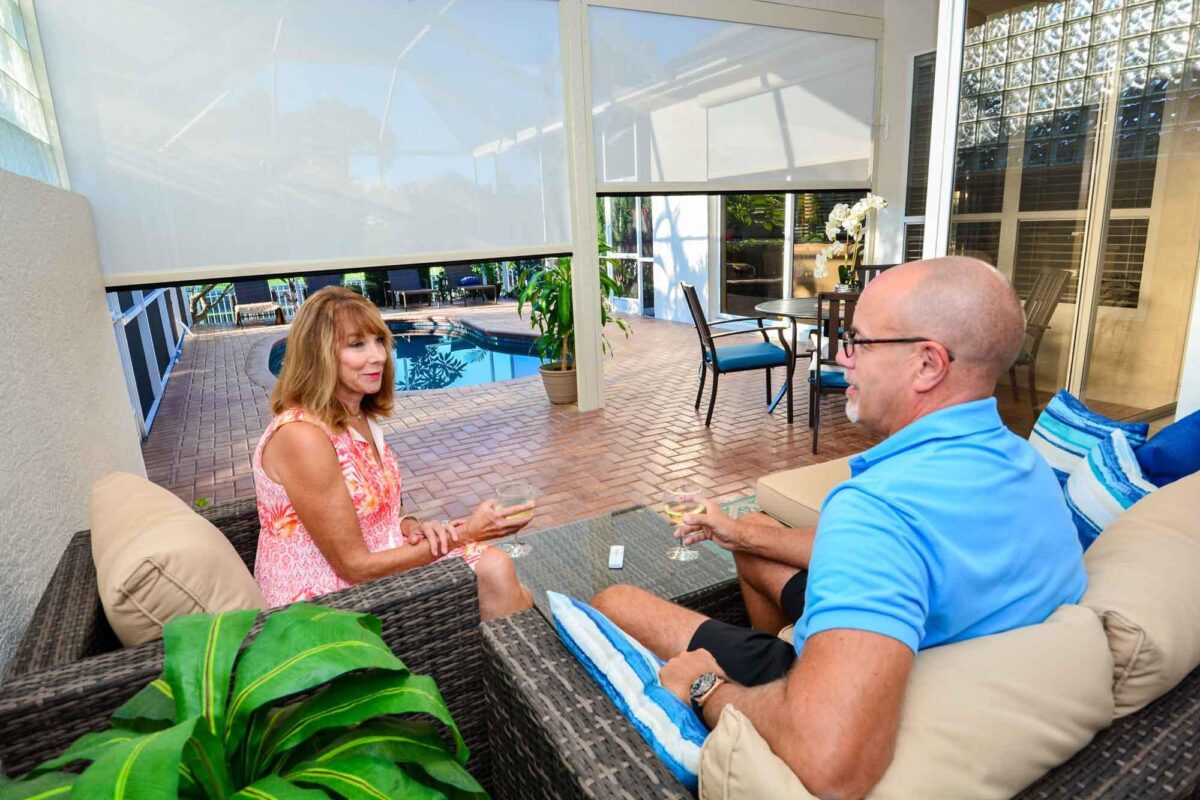
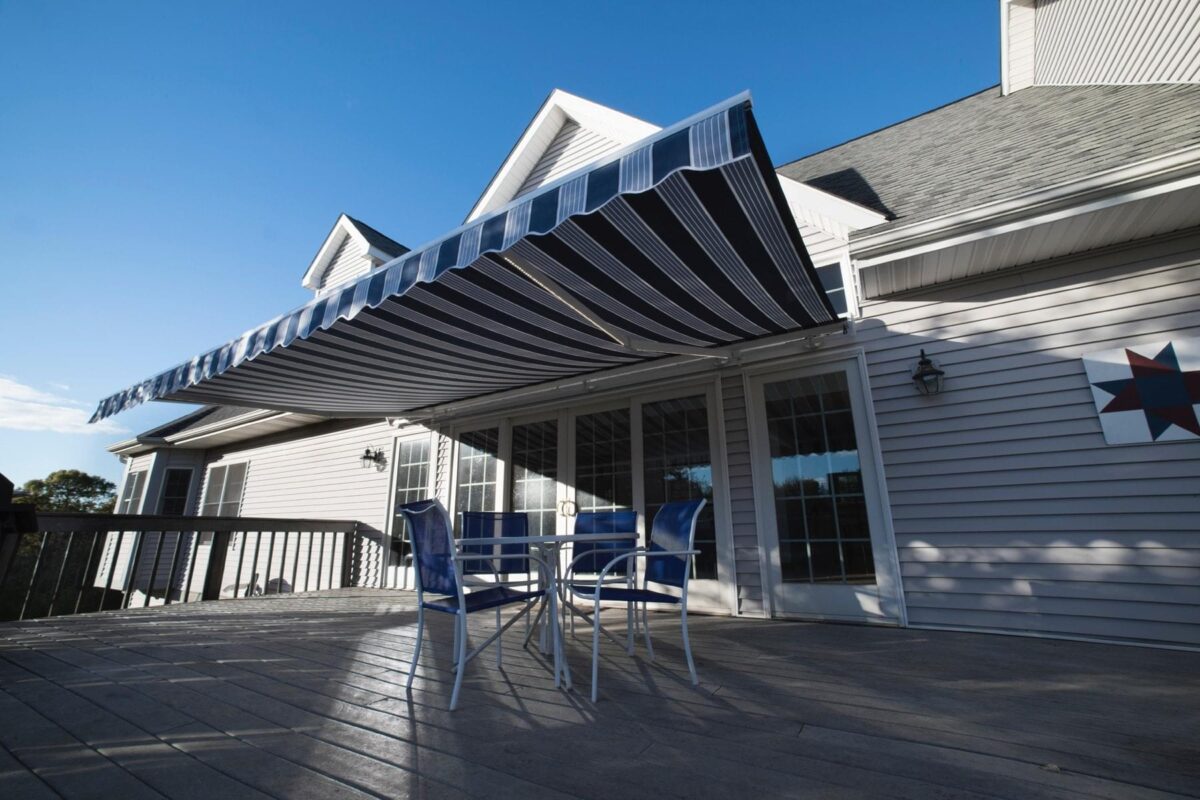
A sample of Shoreline Shade shade, screen, and awning installations.

Why East Lyme homeowners choose Shoreline Shade
- ✓Twenty minutes away, not two hours — we work this stretch of shoreline every week and service what we install
- ✓You deal with the owner — Thomas Magnoli measures and quotes; there is no call centre and no commission handoff
- ✓Coastal specification by default — aluminum housings and stainless fasteners because we know what salt air does
- ✓Custom fabrication only — every shade is built to your opening, never trimmed from stock sizes on site
- ✓Warranty-backed products — we stand behind both the hardware and our installation of it
- ✓Honest recommendations — if a manual shade serves you better than a motor, we will say so
Serving East Lyme and the surrounding shoreline
We install exterior solar shades, motorized screens, and retractable awnings throughout southeastern Connecticut.
Niantic
Old Lyme
Waterford
Salem
Montville
Oakdale
New London
Clinton
Madison
Old Saybrook
Colchester
East Lyme exterior solar shade questions, answered
Can exterior solar shades stay up through a Connecticut winter?
Many can, particularly zip-tracked systems under a soffit or deep overhang. On fully exposed elevations near the water we generally recommend retracting the shade for the season and, on some systems, removing the fabric. We will tell you which category your specific installation falls into at the estimate rather than leaving you to guess.
Will a solar shade hold up to wind coming off Niantic Bay?
A shade hanging free on a windy exposure will move, and movement wears fabric. That is exactly why we specify side channels or zip-guided tracks on waterfront and near-waterfront installations. Motorized systems can also be paired with a wind sensor that retracts the shade automatically above a set threshold.
How much will this actually lower my cooling bill?
It depends on exposure, glass area, and how hard your system was working before. Shading a large west-facing slider is the single highest-impact case and often produces a very noticeable difference in both comfort and runtime. A north-facing window is closer to a glare fix than an energy fix. We would rather set an honest expectation than sell you a number.
Can I still see out at night?
Solar shade fabric works by contrast, so it is see-through toward the brighter side. During the day you see out clearly. After dark, with interior lights on, the effect reverses and visibility drops considerably — which most homeowners find useful for privacy. If night-time views matter to you, a higher openness or a retractable system is the better fit.
What is the lead time?
Because every shade is custom-fabricated, expect roughly three to six weeks from approved order to installation for most systems, and longer for premium imported hardware. If you want shades working by July, ordering in early spring is the right move — we cover the seasonal timing in our post on the best time of year to install.
Do you serve Niantic and the beach associations specifically?
Yes. Niantic, Crescent Beach, Black Point, Giants Neck, and the surrounding associations are regular work for us. If your association has architectural review requirements, tell us at the estimate and we will spec colours and hardware profiles that clear approval.
Get a free estimate for your East Lyme home
We serve East Lyme, Niantic, and the surrounding shoreline towns from our base in Clinton, CT. Call Thomas Magnoli directly or request an on-site estimate online — no call centres, no sales handoffs.
Request a Free On-Site Estimate
Or call: (860) 510-3862