
Wind Protection for Outdoor Living · Connecticut
Windbreak Screens for Connecticut Decks and Patios: Stopping the Wind Without Losing the View
Sun you can shade. Bugs you can screen. Wind is the problem most Connecticut homeowners never plan for — and it is the one that empties a beautiful deck fastest. Here is what actually works, including the counterintuitive part.
Why wind is the underrated problem on a Connecticut deck
People plan outdoor spaces around sun and insects. Both are visible problems with obvious products. Wind gets ignored until the deck is finished, and then it quietly makes the space unusable in ways that are hard to articulate: the umbrella will not stay up, napkins leave the table, candles will not light, and a 68-degree evening feels cold enough that everyone drifts inside.
On the Connecticut shoreline this is not a marginal effect. A steady onshore breeze off Long Island Sound runs most afternoons through the summer, and on exposed lots at Cornfield Point, Black Point, or anywhere out toward Fenwick it is effectively constant. Inland it shows up differently — a deck on a hillside lot in Colchester or a ridge in Killingworth can funnel wind in a way the surrounding woods disguise until you put furniture out.
The frustrating part is that wind protection is genuinely solvable, and it is usually cheaper than the shade solution people buy instead. It just requires understanding one piece of physics that runs against intuition.
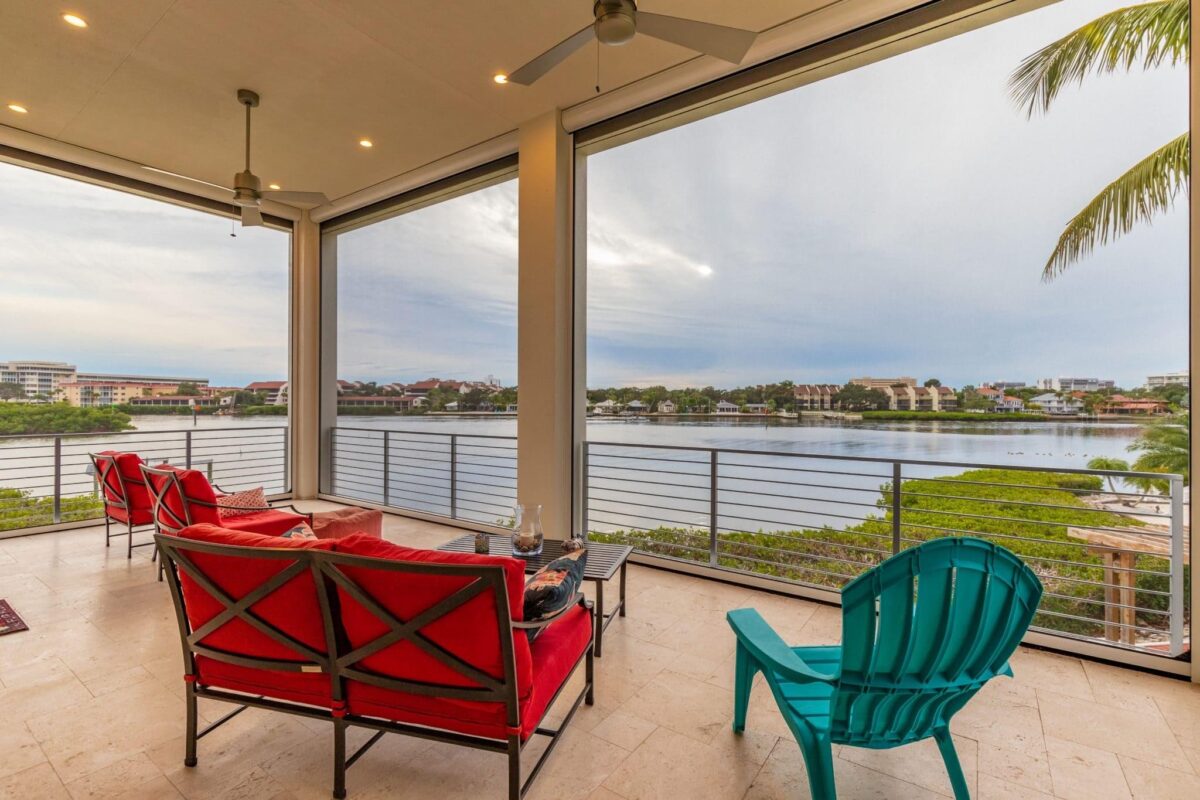
A porous mesh panel on the windward side calms a deck more effectively than a solid barrier of the same height.
The counterintuitive part: solid barriers work worse
The instinct is that if wind is the problem, you want a wall. A solid panel, a glass balustrade, something the air cannot get through. In practice, a solid barrier is one of the least effective windbreaks you can build.
Here is why. When moving air hits a solid obstruction it does not stop, it goes over. On the far side it curls back down into the low-pressure pocket behind the barrier, creating turbulence and downdraught. You get a narrow band of genuine calm immediately behind the wall, then a zone of swirling, gusty air — often right where the seating is. Anyone who has sat behind a solid fence on a windy day has felt this without knowing the mechanism.
A porous barrier behaves differently. It lets a portion of the air through, which bleeds off the pressure difference and prevents that recirculation. The air on the far side is slowed rather than redirected, and the calm extends much further downwind — commonly eight to ten times the barrier height, versus two or three for a solid wall.
The practical target is roughly 40 to 50 percent porosity: a mesh that lets about half the air through. This is well-established in agricultural and landscape windbreak design, and the U.S. Department of Energy covers the same principle in its guidance on energy-efficient landscaping for shelterbelts and windbreaks.
The upshot for a deck: a mesh screen is not a compromise on a wall — it is the better engineering answer, and it happens to also preserve your view and cost less. That is an unusually happy alignment.
The realistic options for a Connecticut deck
| Option | Wind performance | View | Notes |
|---|---|---|---|
| Retractable mesh screen | Very good — porous by design | Preserved when retracted | Needs overhead structure. Our usual recommendation. |
| Fixed mesh panel | Very good | Always partly obstructed | Cheapest effective option. Permanent look. |
| Solid privacy panel / fence | Poor to moderate — turbulence downwind | Blocked | Better for privacy than for wind, despite appearances. |
| Glass balustrade | Moderate — same turbulence issue | Excellent | Expensive, and shows salt spray constantly on the shoreline. |
| Planting / hedge | Very good once established | Blocked, softly | Free physics, slow timeline. Years, not weeks. |
| Retractable awning | Minimal — and must retract in wind | N/A | Solves sun, not wind. Different product. |
That last row matters, because it is the most common mismatch we are asked to fix. A retractable awning is a sun product. In real wind it has to be retracted for its own protection, which means on exactly the days wind is the problem, the awning is not deployed. If wind is your primary complaint, an awning is the wrong purchase — see our comparison of motorized screens versus retractable awnings for where each genuinely fits.
How retractable windbreak screens work in practice
Mechanically these are the same systems we install for insects and glare: aluminum housing above the opening, mesh on a motorised roller, vertical side channels, weighted bottom bar. What changes for a wind application is the specification.
Side channels stop being optional
For a bug screen on a sheltered porch, a free-hanging mesh with a bottom bar is adequate. For a windbreak it is not. Without channels the mesh billows, the edges lift, wind gets around it, and the fabric wears at the guide points. Zip-track systems — where the mesh edge is captured in a continuous channel — are the right specification for genuinely exposed elevations, and they hold tension far better than a simple channel.
Mesh choice shifts
Standard insect mesh has very low porosity, which sounds good for wind but actually loads the system heavily and flexes the fabric. A slightly more open weave designed for wind and solar applications performs better and lasts longer. On a west-facing deck a solar mesh does double duty, cutting glare and wind together.
A wind sensor becomes worth its cost
This is the part most homeowners skip and later wish they had not. A wind sensor retracts the screen automatically above a threshold you set. That protects the system in a genuine storm, when nobody is home to think about it. On a shoreline property we consider it close to mandatory, and it integrates with the same control platforms covered in our smart home shade integration guide.
What windbreak screens cost in Connecticut
Installed pricing for zip-track and channel-guided systems specified for wind. Cheaper free-hanging screens exist, and on an exposed deck they are a false economy.
| Scope | Manual | Motorized |
|---|---|---|
| Single bay (up to 10 ft) | $1,400–$2,600 | $2,400–$4,200 |
| One exposed side (12–20 ft) | $2,600–$4,800 | $4,000–$7,500 |
| Two sides / wrap | $5,000–$9,000 | $8,000–$15,000 |
| Full multi-bay enclosure | — | $15,000–$32,000+ |
Zip-track systems typically add 20 to 35 percent over standard channels, and a wind sensor with controls runs $300 to $700. The good news on cost: you usually only need to screen one or two sides. Prevailing wind on a given deck comes from a consistent direction, and treating the windward side often solves the whole space. We work that out during the site visit rather than quoting the full perimeter by default.
Attachment and structure — the part that fails
A windbreak screen transfers real load into whatever it is fastened to. That is the fundamental difference from a bug screen, and it is where installations go wrong.
If we look at your deck and conclude the structure cannot carry a wind-rated screen, we will tell you that rather than install something that will loosen in two seasons. That occasionally means recommending a carpenter first, which is not the outcome either of us wanted but is better than the alternative.
Common questions
Will a mesh screen really make a noticeable difference, or just take the edge off?
On a well-specified installation the difference is obvious and immediate — the kind of thing people comment on unprompted. Candles stay lit and light furnishings stop moving. It does not create dead-still air, and you would not want it to; you want the breeze slowed, not eliminated, or the space gets stuffy.
How do I know which side the wind comes from?
Most homeowners already know from experience which direction is the problem. On the Connecticut shoreline the prevailing summer breeze is generally onshore, from the south or southwest during the afternoon. We check the exposure on site and, if you are unsure, suggest paying attention for a week before committing — it is a cheap way to avoid screening the wrong side.
Can it stay down in a storm?
No, and no installer should tell you otherwise. A deployed screen in high wind is a sail. That is precisely why we specify a wind sensor: it retracts automatically past a threshold, including when you are away. Systems that get destroyed are systems that were left deployed.
Does it help with privacy too?
Somewhat, and you can bias the mesh toward privacy if that matters. Be aware of the trade-off: a denser privacy mesh has lower porosity, which reduces wind performance and increases load on the system. If privacy is the main goal and wind is secondary, that is a different specification conversation.
Will it help in shoulder season?
This is the underrated benefit. Cutting wind meaningfully extends how late in the year a deck stays comfortable — often several weeks either side of summer. Combined with an infrared heater, a wind-screened space in Connecticut is genuinely usable well into October.
Do you install these across the shoreline?
Yes — we work from Clinton through the Connecticut shoreline, New Haven, Middlesex and New London counties, and into Fairfield County. Exposed waterfront decks are a regular application for us, and we specify them differently from inland installations.
Pairing wind protection with heat and shade
Wind is rarely the only complaint. On most Connecticut decks it arrives alongside afternoon glare in summer and a hard stop to the season in October, and the three problems are worth solving together rather than in three separate purchases.
The combination we install most often on exposed shoreline decks is a solar-weave retractable screen on the windward side, a retractable awning or exterior shade on the sun side, and an infrared heater under the covered portion. The screen slows the breeze and cuts glare, the awning handles overhead sun, and the heater buys you six to eight weeks either side of summer. Individually each is a modest improvement. Together they change how many months of the year the space gets used, which is the only measure that matters.
If you are budgeting in stages, the order we recommend is wind first, then sun, then heat. Wind is the cheapest to fix and usually the biggest single change in comfort. Sun is the most visible and the easiest to add later. Heat is genuinely optional until the first two are handled, because a heater fighting a steady breeze is just an expensive way to warm the outdoors.
For the sun side of that equation, our breakdown of retractable awning costs in Connecticut and our guide to choosing an exterior solar shade cover the options and real pricing.
Seasonal care for a wind-exposed screen
Wind applications wear faster than sheltered bug screens, simply because the fabric and hardware cycle under load. The maintenance is still trivial, but skipping it shortens the life of the system noticeably.
Twice a season, rinse the mesh with plain water and run a cloth down the side channels. Grit accumulating in a channel is the single most common cause of a screen that will not run smoothly, and on the shoreline that grit is salt and sand. Check the bottom bar latches or seats correctly, and look at the fabric where it enters the channels — that is where wear shows first, and catching it early means a fabric replacement rather than a hardware repair.
Retract the screen for winter. Leaving mesh deployed through Connecticut freeze-thaw cycles and February gales is how a system that should last a decade becomes a five-year product.
Is wind the reason you are not using your deck?
Tell us which side the wind comes from and we will tell you honestly what it would take to fix it — including when the answer is one screen rather than four. Free on-site assessment across the Connecticut shoreline.