
Seasonal Guide · Connecticut Shoreline
How to Winterize a Retractable Awning in Connecticut: What to Do Before the First Nor’easter
A quality retractable awning will last 15 to 20 years on the Connecticut shoreline — but only if it goes into winter the right way. Here is exactly what to do each fall, what to skip, and the one mistake that voids more warranties than any other.
Why Connecticut winters are hard on awnings
Retractable awnings are engineered for sun and light weather, not for what a Connecticut winter delivers. Three things do the damage. Snow load is the most destructive: even a few inches of wet coastal snow on an extended awning puts hundreds of pounds of force on arms that were designed to hold fabric taut, not carry weight. Ice is second: meltwater that refreezes inside a folded fabric roll or around a pivot joint expands and stresses stitching, fabric coatings, and hardware. Wind is third: winter storms off Long Island Sound routinely gust past 50 mph, and an awning caught extended in that kind of wind can fold arms backward over the top of the mounting bar.
None of this is a reason to avoid owning an awning here. It is a reason to spend one afternoon each fall putting it away properly. The full procedure takes under two hours for most homeowners, and the payoff is a system that still runs smoothly a decade later.
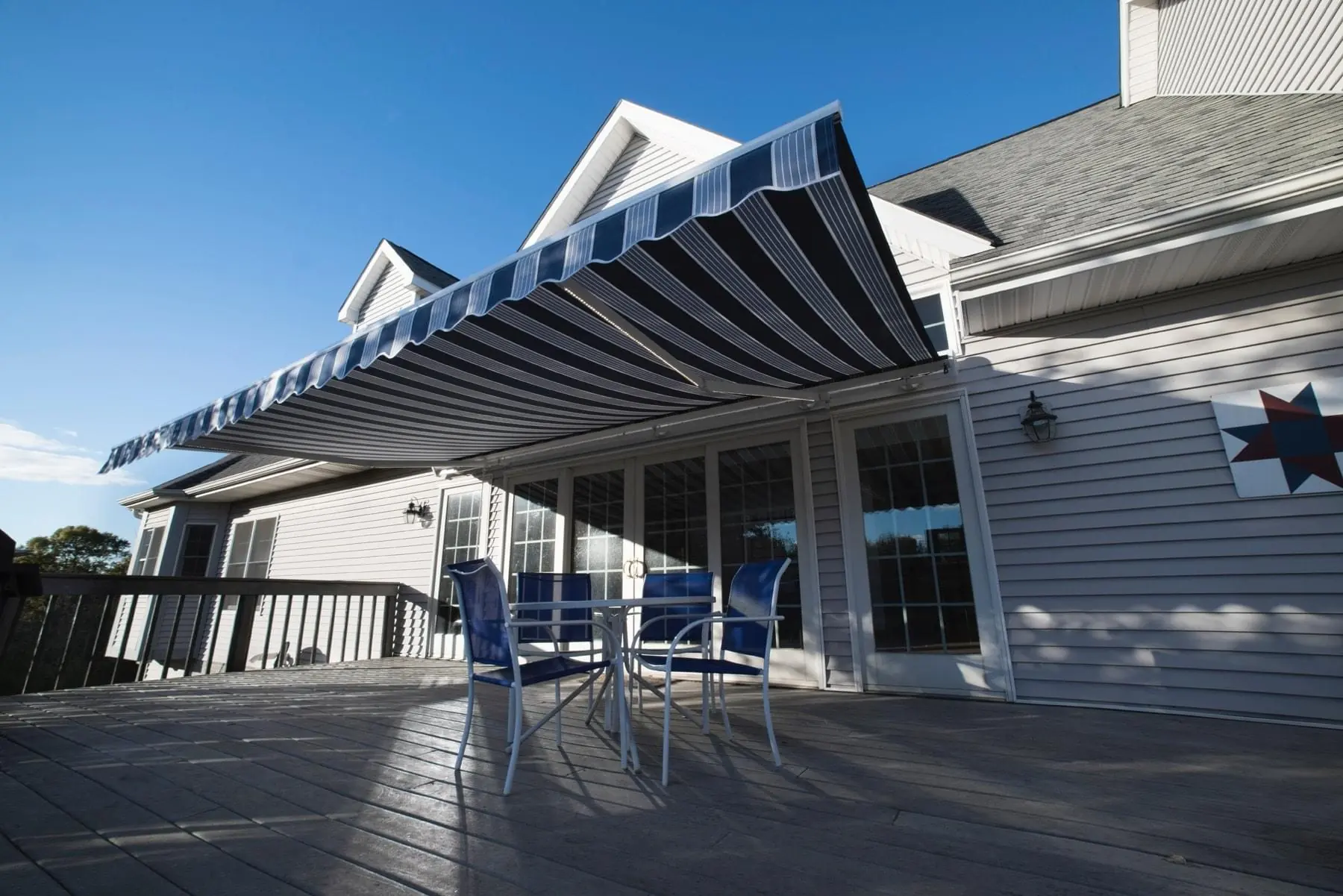
Late-season use is fine — the goal is simply to have the system cleaned, dried, and retracted for good before consistent freezing weather arrives.
The fall winterization procedure, step by step
1. Pick a dry week in early-to-mid October
The single most important rule of winterizing an awning is that the fabric must be completely dry before it is rolled up for the season. Fabric rolled wet and left for four months grows mildew inside the roll, and mildew staining inside a rolled awning is the most common form of spring damage we see. Watch the forecast and choose a stretch with two or three dry days.
2. Clean the fabric before storage
Extend the awning fully and brush off loose debris with a soft broom, working from the house outward. Leaves left in the roll hold moisture all winter and print tannin stains into acrylic fabric. If the fabric has visible soiling, clean it now rather than in spring — a soft brush, lukewarm water, and mild soap, rinsed thoroughly. Our Sunbrella maintenance guide covers the full cleaning procedure and what never to use on acrylic fabric.
3. Let it dry completely, then dry it some more
After cleaning, leave the awning extended until every part of the fabric is dry to the touch, including the underside and the section nearest the roller where drying is slowest. In October humidity this genuinely takes a full sunny day, sometimes two.
4. Inspect hardware while it is extended
With the awning out, look at what you can see without disassembling anything: pitch of the arms, condition of the stitching along seams, cracks in plastic end caps, and any play in the mounting bar where it meets the wall. Run the motor or crank through a full cycle and listen. Grinding, clicking, or hesitation is much cheaper to address in October than in May, when every awning company in Connecticut is booked solid. Our repair and replacement guide explains which symptoms matter and which are cosmetic.
5. Retract fully and cut power to the motor
Retract the awning completely and confirm the fabric roll sits fully inside the cassette if you have a full-cassette model. For motorized systems, switch off the circuit or unplug the transformer so a winter power surge or a curious guest cannot extend the awning onto a snow-loaded deck in January. If you have a wind sensor, it does nothing while the awning is retracted, so this is purely about preventing accidental extension.
6. Fit the protective cover, or confirm the cassette seals
Open-roller and semi-cassette awnings should get a weather sleeve for the winter — a fitted polyester cover that keeps ice and windblown grit out of the folded fabric. Full-cassette models enclose the fabric completely when retracted and do not need a separate cover. If you are not sure which type you own, look at the retracted awning from below: if you can see fabric, it needs a sleeve.
The warranty killer: extending the awning “just for a nice day” in February and forgetting it when snow moves in overnight. Nearly every manufacturer excludes snow-load damage from warranty coverage, and bent lateral arms are typically a $600 to $1,500 repair. Once the awning is winterized, leave it winterized until spring.
Should you remove the awning entirely for winter?
For wall-mounted retractable awnings, no — removal is unnecessary, risks damaging the mounting hardware, and reinstallation costs more than it protects. The exceptions are freestanding awnings on exposed decks, fabric that is already failing and due for replacement, and oceanfront properties that take direct storm exposure, where we occasionally recommend seasonal removal of the fabric only. If you think your exposure justifies it, ask us during a fall service visit rather than attempting fabric removal yourself; refitting fabric onto a roller tube with correct tension is not a DIY job.
What a professional fall service adds
A professional winterization visit covers everything above plus the items that need tools and training: checking arm pitch against factory specification, tightening mounting bolts to torque, lubricating pivot points with the correct dry lubricant, testing motor amperage draw for early signs of wear, and verifying the wind sensor calibration. It typically pairs with a spring recommissioning visit. For most residential systems the two-visit package costs less than a single lateral-arm repair.
Spring recommissioning: the other half
Winterizing is half the job; bringing the awning back correctly is the other half. In April: remove the sleeve, extend on a dry day, inspect fabric for winter damage before regular use, restore power, and run two or three full cycles while listening. If anything changed over the winter — new noises, hesitation, sagging fabric — deal with it before the season starts. Spring is also when to decide on replacement if the fabric is at end of life; our guide to the best time to install a retractable awning in Connecticut explains why early-spring orders beat June orders by weeks of lead time.
Frequently asked questions
Can I leave my retractable awning extended in winter if it is under a covered area?
If the awning is genuinely protected from snow accumulation and wind — under a deep roof overhang, for example — extended storage is less harmful, but retracted is still better. Fabric under tension for months in freezing temperatures ages faster than fabric stored on the roll, and there is rarely a reason to leave it out.
Do I need to winterize a motorized awning differently from a manual one?
The fabric care is identical. The additions for motorized systems are cutting power after retraction and, ideally, an annual motor health check. Motor manufacturers rate units for cold storage, so the winter itself does not harm a healthy motor that is switched off.
What temperature is too cold to operate a retractable awning?
Most manufacturers advise against operating below roughly 32°F, mainly because fabric becomes stiff and ice may have formed inside the roll or on the arms. If the awning has been properly winterized this never comes up, because it stays retracted from October to April.
How much does professional awning winterization cost in Connecticut?
A standalone fall service visit for a residential retractable awning typically runs $150 to $300 depending on size and access. Paired fall and spring visits are usually discounted together. Compare that to $600 to $1,500 for a lateral arm replacement and the economics are straightforward.
Serving the Connecticut shoreline and beyond
Want your awning winterized by the people who installed it?
Shoreline Shade offers fall winterization and spring recommissioning visits across the Connecticut shoreline. One visit each fall protects a five-figure installation for the price of a dinner out.