
Porch Enclosure Comparison · Connecticut
Screen Rooms vs. Retractable Screens in Connecticut: Which Porch Enclosure Actually Fits Your Home?
Both keep the mosquitoes out. They are very different products with different costs, different permitting, and different consequences for how your house looks in February. Here is how to choose.
The two products, plainly described
Connecticut homeowners searching for a “screen room” and homeowners searching for “retractable screens” usually have the same problem: a porch, deck, or patio that becomes unusable from late June through September because of mosquitoes. Where they differ is what they are willing to change about the house permanently.
A fixed screen room (screened porch)
A screen room is construction. Aluminum or wood framing is built into the openings of your porch, screen panels or spline-set mesh go into that framing, and it stays there. Many include a kickplate at the bottom, a screen door, and sometimes a knee wall. Done well it looks like it was part of the original house. Done badly it looks like a cage bolted onto a nice porch.
The defining characteristic is that it is always on. You are always looking through mesh, in every season, from both inside and outside the house.
A retractable screen system
A retractable system puts fabric mesh on a motorised roller inside an aluminum housing above each opening. Press a button and the mesh drops on side channels to enclose the space. Press it again and the mesh disappears entirely into the housing. In October, your porch is simply an open porch again.
The trade-off is that it needs overhead structure to mount to, it has a motor, and per opening it usually costs more than the equivalent panel of fixed screen.
There is a third option worth naming: a three-season room with glass or vinyl glazing. That is a genuine addition with insulation, electrical, and often a foundation — a different budget and a different contractor. We install shade and screen systems, not room additions, and we will tell you when what you actually want is a builder.
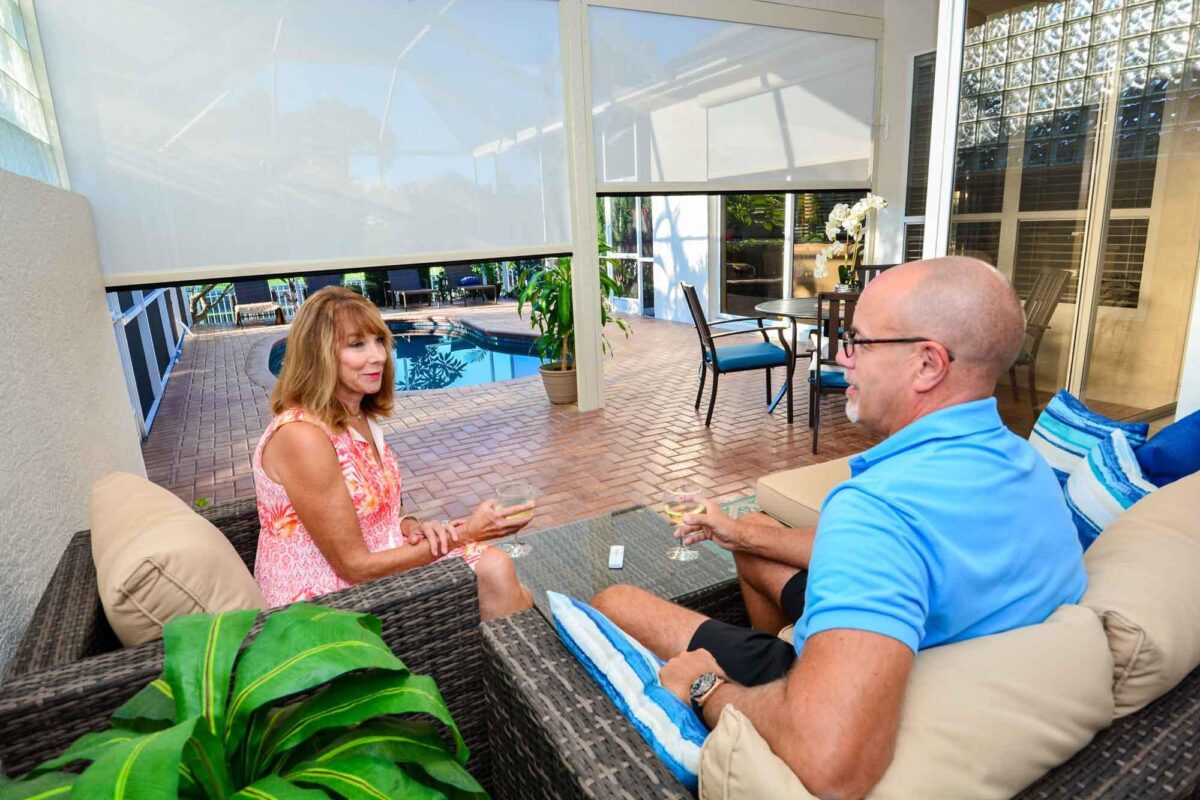
A retractable system encloses the same opening a screen room would — but only when you want it to.
Head to head
| Fixed screen room | Retractable screens | |
|---|---|---|
| View when not in use | Always through mesh | Completely unobstructed |
| Winter appearance | Enclosed year-round | Open porch again |
| Needs overhead structure | No — can build its own frame | Yes — hard requirement |
| Bug seal quality | Excellent, no moving parts | Excellent with side channels and sealing bottom bar |
| Cost per opening | Lower | Higher |
| Moving parts to service | Screen door hinges only | Motor, roller, channels |
| Storm damage exposure | Panels can be torn | Retract it and nothing is exposed |
| Building permit | Usually yes | Usually no |
| Best for | Dedicated screened porch you want every day | Porches with a view, or spaces used seasonally |
What each costs in Connecticut
These are installed ranges for quality work. A screened porch quote that comes in dramatically below the low end usually means residential-grade screen in light framing, which is exactly what tears in the first real storm.
| Scope | Fixed screen room | Retractable screens |
|---|---|---|
| Single opening / doorway | $400–$1,200 | $1,000–$2,400 |
| Medium bay (8–12 ft) | $900–$2,200 | $2,200–$4,000 |
| Typical covered porch (3–4 bays) | $4,000–$11,000 | $8,000–$18,000 |
| Large wraparound porch | $9,000–$22,000 | $18,000–$40,000+ |
The gap narrows on small jobs and widens on big ones, which is the opposite of what most people assume. For a full wraparound porch, fixed screen is meaningfully cheaper. For a single slider or a French door, the difference is a few hundred dollars and the retractable system is usually the better buy. Our Connecticut motorized screen cost guide breaks the retractable side down further.
How to actually decide
The Connecticut-specific considerations
Mosquito pressure is a genuine health question here
This is not just comfort. Connecticut runs a statewide mosquito trapping and testing programme, and West Nile virus turns up in trapped populations across Fairfield, New Haven, and New London counties most seasons. The state publishes weekly results through the Mosquito Management Program. If you have young children and a wooded or wetland-adjacent lot, enclosing the space you spend summer evenings in is a reasonable precaution rather than a luxury.
Winter is the deciding factor more often than people expect
A screened porch in Connecticut is enclosed for roughly seven months during which you are not using it as a screened porch. Snow blows through mesh and piles on the floor. Panels take wind loading all winter. Many homeowners end up installing removable winter panels, which is a second product and a seasonal chore. A retractable system simply retracts in October and the problem does not exist.
Salt air on the shoreline
Within a mile of the water, specify powder-coated aluminum framing and stainless fasteners for either product. Steel components stain and seize. This is a small line item that determines whether the installation still looks right in year eight, and it is the same principle we apply to exterior shade installations on the shoreline.
Permits: the difference that surprises people
Building a fixed screen room usually means enclosing an existing structure, and in most Connecticut municipalities that requires a building permit. If the porch itself is being built or re-framed, that is unambiguously permitted work with inspections. Some towns also count a screened enclosure toward lot coverage.
Retractable screens mounted to an existing structure generally do not require a permit, because you are not altering the structure or enclosing conditioned space. That is not a universal rule and we always suggest a quick call to your building department, but in practice it is one of the quiet advantages of the retractable approach — particularly on shoreline properties where flood-zone review can complicate any structural work.
What about RV and camper enclosures?
We get asked about this regularly and it deserves a straight answer. Screen and awning enclosures for RVs and campers are a distinct product category, generally sold through RV dealers and built to attach to an existing awning rail on the coach. They are lighter, designed to be taken down and packed, and not what we manufacture or install.
Where we can help is the fixed side of a seasonal site — a deck, a covered porch structure, or a permanent patio at a seasonal property. If it is a structure with a roof, retractable screens will work on it. If it attaches to the vehicle, talk to an RV outfitter.
Common questions
Can I combine the two?
Yes, and it is often the smartest answer. A common configuration is fixed screen on the side and back openings that nobody looks through anyway, and retractable systems on the one or two openings that face the view. You get the cost advantage where it does not matter and the view advantage where it does.
Do retractable screens really seal as well as a screened porch?
With side channels and a bottom bar that meets the deck properly, yes. The failures we get called to fix are always gaps, not mesh — an uneven deck surface the bottom bar cannot seal against, or a side channel that was not sealed to the post. Getting the edges right is most of the job, and it is where cheap installations cut corners.
How long does each take to install?
A retractable system is quick on site — two to four hours per opening — but custom fabrication runs three to six weeks first. A fixed screen room is the reverse: little lead time on materials, but several days to a week of on-site carpentry, plus permit time before that. Plan either around the seasonal install queue.
Which one lasts longer?
Fixed screen framing will outlast a motor, straightforwardly. But mesh is the wear item in both cases and lasts roughly 7 to 12 years either way. On a retractable system, mesh is normally replaceable without touching the housing or motor. Neither product is disposable if it was specified properly.
Can you screen a patio that is under a deck?
Usually yes, and it is one of our favourite applications. The deck above provides the overhead structure a retractable system needs, and the space underneath is often unused precisely because of bugs. Joist depth and drainage need checking, which we do at the measurement visit.
Do you install fixed screen rooms as well as retractable?
Our specialism is retractable and motorized systems — screens, awnings, and exterior shades. For a full framed screened-porch build we will happily tell you honestly that a carpenter is the right call, and we would rather do that than sell you a retractable system for a job it does not suit. See our retractable screen options for what we do install.
The mesh matters more than the frame
Whichever product you choose, the mesh is what you will actually look through for the next decade, and it is the specification homeowners think about least. Standard fibreglass insect screen is the default in most quotes. It works, it is cheap, and on a porch with a view it is the wrong choice.
Solar or shade mesh blocks 80 to 90 percent of solar heat alongside insects, which matters enormously on a west-facing porch. Privacy mesh limits sightlines from a road or a close neighbour but darkens the space considerably at dusk. High-clarity or so-called invisible mesh costs a premium and delivers a genuinely different experience — on a waterfront porch it is usually worth it, and the difference is obvious when you hold two samples side by side rather than reading about it.
Ask for physical samples, outdoors, in daylight. Mesh reads completely differently under showroom lighting, and this is the one decision that is expensive to change later.
Five questions to ask before you sign anything
These separate a contractor who has done this properly from one who is guessing, and they apply to both products.
Not sure which one your porch needs?
We will look at the opening, the structure above it, and what you actually want to use the space for — then tell you which approach fits, including when the answer is not the one we sell. Free on-site assessment across the Connecticut shoreline and beyond.