
Sun Angle · Orientation · Shade Planning
Where Does a Connecticut Patio Need Shade? Sun Angle and Orientation for South-, West- and East-Facing Patios
The direction your patio faces decides when it is too hot, how low the sun comes in, and which kind of shade will actually work. Here is how to read your own space before you buy anything.
Short answer: On a south-facing Connecticut patio, the sun is high and strong at midday, so an overhead retractable awning does most of the work. On a west-facing patio, the afternoon sun comes in low, so you usually need a vertical screen or solar shade as well as an overhead awning. An east-facing patio gets gentle morning sun that often needs little more than an adjustable awning or screen. Your trees, roofline and neighbors can change all of that.
By Shoreline Shade, LLC, Clinton, Connecticut · Last updated October 2026
In this guide
- How does the sun move over a Connecticut patio?
- What shade does an east-facing patio need?
- What shade does a south-facing patio need?
- What shade does a west-facing patio need?
- What about north-facing and corner patios?
- Which shade product fits which patio?
- How far should an awning project, and how high should it mount?
- How do trees, rooflines and neighbors change the answer?
- A simple sun survey you can do yourself
- When shade is not the answer
- Frequently asked questions
- Get shade matched to how your patio faces
How does the sun move over a Connecticut patio?
Connecticut sits at roughly 41 to 42 degrees north of the equator. At that latitude, the sun’s path changes a lot over the year, and that is why a patio can feel completely different in June than in March.
| Time of year | Sun height at midday (approx.) | Where it rises and sets | What it means for a patio |
|---|---|---|---|
| Summer solstice (late June) | About 72 degrees above the horizon | Northeast to northwest | High, strong midday sun. Overhead shade works well. Early and late sun comes in from the sides |
| Spring and fall equinox | About 48 degrees | Due east to due west | Moderate height. A projecting awning shades the near part of the patio for much of the day |
| Winter solstice (late December) | About 25 degrees | Southeast to southwest | Low sun. It reaches deep under an awning and into the house. Many owners want this, not shade |
Those numbers are the geometry of our latitude, not a product rating. You can check them for your exact address with the NOAA solar calculator, which shows the sun’s height and direction for any place and date.
There are two things to take from the table. First, the sun is high in the summer middle of the day and low in the morning and evening. Second, the compass direction your patio faces determines which of those times you get.
What shade does an east-facing patio need?
An east-facing patio gets direct sun in the morning and is in shade by afternoon. That is usually the most comfortable orientation. Morning sun is lower and gentler, the air has not heated up yet, and by the hottest part of the day the house itself is shading the patio.
The common complaints on east patios are glare at breakfast and early heat in the middle of summer, when the sun rises in the northeast and comes in at an angle. If you want to eat or work outdoors at 8 or 9 am, shade can make a real difference. If you mostly use the patio in the evening, an east patio may need very little.
A retractable awning is a good fit because it can be extended for the morning and retracted when you want the light. On the sides of a patio, a motorized screen can block low sun that skims in from the north or south edge.
If the patio is a seasonal space and you love the morning sun in spring and fall, that is a point in favor of a retractable product over a permanent roof. You can have shade in July and sun in April.
What shade does a south-facing patio need?
A south-facing patio sees the sun high overhead for most of the day. In summer, it is bright and hot from late morning to mid-afternoon. In winter, the low southern sun is welcome and can warm the house.
This is the orientation where an overhead awning does best. With the sun high in the sky in summer, a projecting awning throws a deep shadow close to the wall, and most of the area under it stays shaded through the middle of the day. That is also true for the windows behind it, which is why awnings help with indoor heat on south sides. Our guide on awnings and cooling costs covers that side. For a deeper technical read, the Lawrence Berkeley National Laboratory report Energy Savings from Window Attachments, prepared for the U.S. Department of Energy, compares awnings and other attachments.
The retractable part matters most here. In summer you want the awning out. In winter you want the low sun to come under it and into the house. A fixed roof or a pergola cannot do both. A retractable awning can. See also our comparison in pergola, patio cover or retractable awning.
If glare through a large glass door is the main problem, an exterior solar shade on the glass can also work. See our guide to choosing exterior solar shades.
What shade does a west-facing patio need?
West-facing patios are the hardest. The sun swings around to the west in the late afternoon and early evening, which is right when many people get home and want to use the patio. It is hot because the air has been warming all day, and it is low, so the sun comes in sideways under any overhead cover.
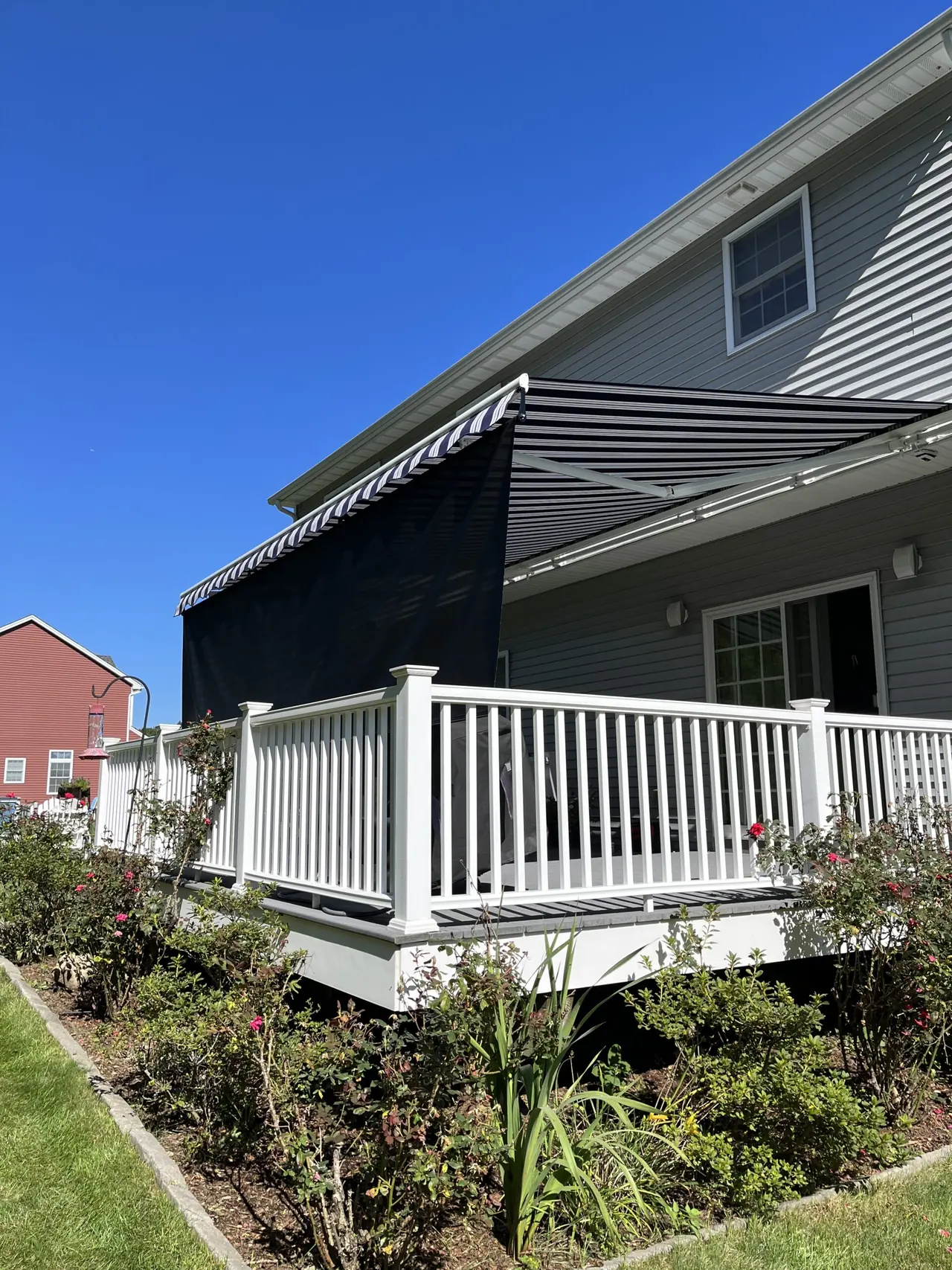
That is the key point about west patios. An awning projecting out from the house shades from above, but low sun shines in from the front or the side, underneath the front edge. You can sit under a good awning and still get sun in your eyes at 5 pm.
A simple example makes the geometry clear. Take an awning front bar about 9 feet above the patio. When the sun is 72 degrees high at midday, that bar’s shadow falls only about 3 feet out from where it hangs. When the sun is down at 25 degrees, the same bar’s shadow falls roughly 19 feet away, so the light slides under the awning and reaches the seating area. Real awnings have pitch, valances and side effects, but the idea holds: the lower the sun, the less an overhead awning helps.
That is why west-facing patios often combine products.
- An awning for overhead sun and the upper part of the glass.
- A motorized retractable screen in solar mesh, which blocks up to 97% of UV according to our product page, on the open west side.
- An exterior solar shade over a big west-facing window or slider to cut afternoon heat before it reaches the glass.
Our town pages for West Hartford and East Lyme go deeper on shades for hot glass.
What about north-facing and corner patios?
A north-facing patio has little direct sun, other than early morning and late evening in midsummer, when the sun rises and sets in the north-east and north-west. Many are used mostly for privacy, wind protection or bug control, so shade is not the main issue. Screens often make more sense than awnings there. See our guides to mosquito protection and windbreak screens.
Corner patios, courtyards and decks that wrap around the house see more than one direction. You may have morning sun on the east side and hot sun on the west side from the same deck. In that case, shade a zone at a time rather than trying to solve it all with one product.
Want someone to read the sun on your patio?
Which shade product fits which patio?
Use this as a starting point. The right answer depends on your trees, your roofline and how you use the space.
| Orientation | Main sun problem | Usually works well | Often needs added |
|---|---|---|---|
| East | Morning glare and early heat | A retractable awning, extended in the morning | A side screen for low sun at the edges |
| South | High midday sun and indoor heat | A retractable awning over the patio and windows | An exterior shade on large glass if glare persists |
| West | Low, hot afternoon and evening sun | An awning plus a vertical screen or solar shade | Solar-mesh screens on the open west side |
| North | Little direct sun | Screens for bugs, wind or privacy | Usually no shade product needed |
Our motorized screens vs retractable awnings guide compares the two main products in detail.
How far should an awning project, and how high should it mount?
The more the awning projects out from the wall, the more shade it throws, especially when the sun is high. Our SunPro retractable awnings are available with a projection of up to 12 feet and widths from 10 to 40 feet. A deeper awning also catches more wind, which is why the right size is a balance, not the largest one possible.
Height matters too. A higher mount puts the shadow of the front bar farther away from the wall at the same sun angle. A lower mount reaches a bit more of the low sun but can crowd a door or window. Pitch also matters. A modest slope sheds rain, and a steeper pitch can help block low sun at the front, though it changes how it looks. We check all of this against the actual wall, door swings and window heights at the estimate. Our post on retractable awning installation explains what we measure.
How do trees, rooflines and neighbors change the answer?
Everything above assumes an open sky, and few patios have one. A large maple on the west side can do more for afternoon heat than any awning, until it loses its leaves. A roof overhang above a south porch can already be shading the glass in summer. A neighbor’s house may block the low western sun in the evening and leave you only the middle of the day to deal with.
Deciduous trees, with leaves in summer and bare branches in winter, are a natural version of the same idea as a retractable awning. If you have one, factor it in. If it is young, remember it will grow and cast more shade each year.
Do not forget seasonal change in what you want. People often shade a patio in July and then regret that it also blocks the winter or early-spring sun they enjoy. A retractable product keeps that choice in your hands. Read our guide to extending your patio season.
A simple sun survey you can do yourself
You can learn most of what we will look at with a phone and one sunny day.
- Find north. A phone compass will do. Write down which direction the back of your house faces.
- Take photos from the patio at about 9 am, 12 noon, 3 pm and 6 pm on a clear day. Look at where the sun hits and what is in shadow.
- Note when it becomes uncomfortable. Is it glare in your eyes, heat on your skin, or sun on a window?
- Check the calendar. The [[https://gml.noaa.gov/grad/solcalc/|NOAA solar calculator]] lets you see where the sun will be in July, even in late fall.
- Mark obstacles. Note trees, roof overhangs, gutters, lights, door swings and windows that might get in the way of an awning or screen.
Send us the photos or have them handy at the estimate. They save time, and they help us suggest a product you will actually use. It is late October as we write this, so the sun is low and the patio may not feel like a shade problem yet. That is a good time to measure and plan, since you can see the low-sun conditions and picture how the same space will behave in July.
When shade is not the answer
If your patio is already in deep shade from trees or buildings for most of the day, an awning will not add much. If the real problem is wind, an awning is the wrong tool and a windbreak or a screen may be better. If the problem is only afternoon heat through one big window, an exterior solar shade may solve it without covering the whole patio. If the patio faces west and you want it usable at 6 pm in July, expect to use more than one product. We will say so at the estimate rather than sell an awning that cannot do the job.
For more ideas, see our guides to patio sunshade installation and porch shades.
Frequently asked questions
Which direction of patio gets the most sun in Connecticut?
South-facing patios get the most total sun, with a high midday sun. West-facing patios get the hottest, lowest sun in the late afternoon and evening, which is often the time people use the patio. East-facing patios get morning sun and are shaded later, and north-facing patios get the least direct sun.
What kind of awning is best for a west-facing patio?
An awning handles the overhead sun, but the low afternoon sun comes in from the side and front. West-facing patios usually do best with an awning plus a vertical solar-mesh screen or solar shade to block low sun. We look at your actual space before recommending.
How high is the sun in Connecticut in summer and winter?
At solar noon, about 72 degrees above the horizon at the summer solstice, about 48 degrees at the equinoxes, and about 25 degrees at the winter solstice. These are approximate figures for a latitude of 41 to 42 degrees north, and the NOAA solar calculator gives exact values for your address.
Does a south-facing patio need an awning?
Often yes. The sun is high and strong for most of the day in summer, and a projecting awning shades the patio and the windows behind it. It is retractable, so in winter you can pull it in and let the low sun warm the house.
How far should an awning project over a patio?
As far as you can reasonably go, balanced against wind and the space around it. Our SunPro awnings have a projection of up to 12 feet. Deeper awnings give more shade when the sun is high but catch more wind. We check height, pitch and obstacles at the estimate.
Can I use an awning and a screen together?
Yes, and that is common on west-facing patios. The awning shades from above, and a vertical screen blocks low sun from the side. Each is its own motorized unit, so you can use them independently. We can price them together at the estimate.
Will a retractable awning block winter sun?
Only when it is extended. A retractable awning can be pulled in to let the low winter sun into the house, which a fixed roof or pergola cannot do. In summer you extend it to shade. That seasonal choice is one of the main benefits of a retractable product.
When is the best time to plan patio shade?
Any time. Late fall is a good moment to see low-sun conditions and plan. Installation timing depends on our schedule and the product, which we cannot promise here, so ask at the estimate. Planning ahead usually beats trying to buy shade in the first heat wave.
Get shade matched to how your patio faces
Tom Magnoli will look at your patio, your sun angles and your trees, then tell you which product fits and which does not, at no cost. Photos of the patio at different times of day help.
Or call (860) 510-3862 · shorelineshadellc@gmail.com