
Power · Wiring · Controls
How Are Motorized Awnings and Screens Powered? Hardwired vs Solar-Assisted Options
What powers a motorized awning or retractable screen, when you need an electrician, whether solar or battery options are realistic in Connecticut, and the questions to ask before you buy.
Short answerMost motorized awnings and retractable screens run on household power, either plugged into a weather-protected outdoor outlet or wired in by an electrician. Our motorized screens use Somfy motors on standard household current with a low-voltage wire to the cassette. Solar or battery options exist on some products from some makers, but check availability and Connecticut’s low winter sun before counting on them, and always ask what happens in a power outage.
Last updated: October 2026. Written by the Shoreline Shade team in Clinton, CT.
In this guide
- How are motorized awnings and screens powered?
- What power options exist, and how do they compare?
- Should it be plugged in or hardwired?
- Do you need an electrician?
- Is solar-assisted power a real option for awnings and screens?
- What happens in a power outage?
- Do the remote, sensors and app need power too?
- How should you plan for power before the installer arrives?
- What should you ask before you buy?
- Frequently asked questions
- Not sure how your awning or screen would be powered?
How are motorized awnings and screens powered?
Most motorized awnings and screens run on mains household power. A motor inside the roller tube or cassette turns the fabric, and a wireless receiver listens for your remote, wall switch or app. The power arrives either through a plug that goes into an outdoor outlet or through a hardwired connection to a switch or junction box. Our motorized retractable screens use Somfy motors that run on standard household current, with a single low-voltage wire run to the screen cassette. Our retractable awnings use Somfy or DOOYA motorization with a wireless remote.
That is the general picture. The exact power arrangement varies by model, motor, accessory list and building, so treat this article as a map of the questions to ask rather than a wiring guide. The product manual and a licensed electrician have the final say on any specific installation.
What power options exist, and how do they compare?
These are the arrangements you are likely to hear about. Availability depends on the product and the maker, so ask which ones apply to your model.
| Option | How it works in general | Strengths | Limits to ask about |
|---|---|---|---|
| Plug-in to an outdoor outlet | Motor or transformer cord plugs into a nearby receptacle | Simple, easy to disconnect for service | Needs a weather-protected GFCI outlet within reach; cords are exposed |
| Hardwired | Wire is run to the motor and connected at a junction box, often with a wall switch | Clean look, no dangling cord, permanent | Requires an electrician and careful routing through the building |
| Low-voltage run to the cassette | A transformer steps power down and a thin cable feeds the motor | Thin wire is easier to hide | Transformer location, cable length and connectors matter |
| Battery-operated | A rechargeable battery pack powers the motor | No wiring needed | Charging routine, cold-weather capacity, availability by model |
| Solar-assisted | A small solar panel charges a battery pack | Useful where running power is hard | Sun exposure, winter performance, panel placement, availability by model |
General descriptions only. Not every option is available for every product.
Should it be plugged in or hardwired?
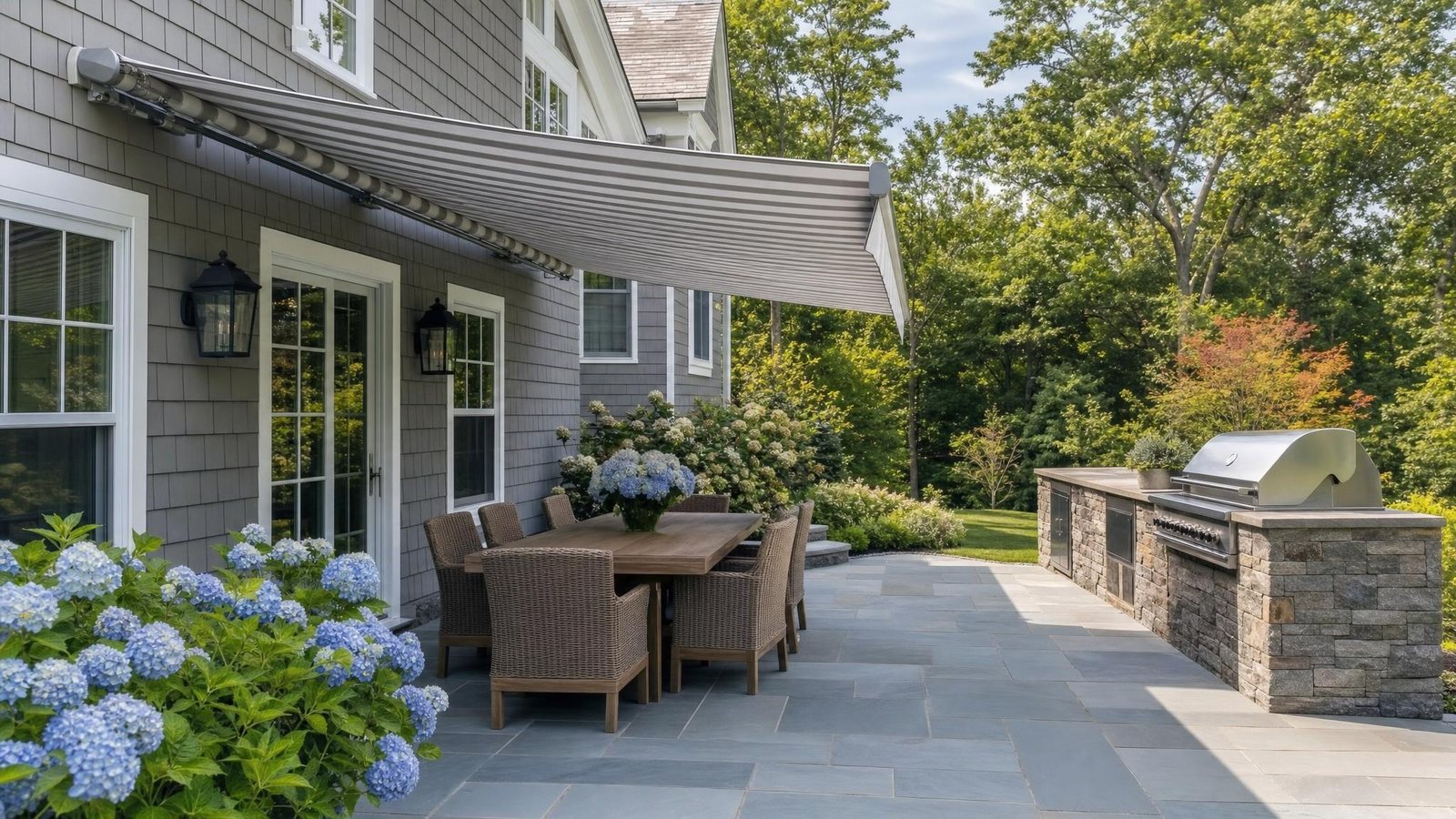
Plug-in is the easier path where a good outlet already exists. The motor cable ends at a plug, the plug goes into a weather-protected outlet, and service is simple because you can disconnect. Hardwired is the better-looking path when the awning or screen is a permanent part of the house, because there is no cord to hang, trip over or tuck behind a planter.
The deciding factors are usually practical rather than aesthetic. How far is the nearest suitable outlet from the end of the unit where the cable leaves? Is there an existing circuit that can take the extra load, or will a new one be needed? Is there an interior wall or soffit that makes routing a wire discreet, or would the cable have to run across siding? An honest installer will look at all three before suggesting an approach.
What about extension cords?
A permanent installation should not depend on a long extension cord run across a patio. Cords are damaged by feet, lawn equipment, snow and sun, and they are not meant for permanent outdoor use. If the only way to power a unit is through a cord, plan on adding a proper outlet instead.
Do you need an electrician?
If a suitable, protected outlet or junction box is already in the right place, you may not need one. If you need a new outlet, a new circuit, wire pulled through a wall, or a hardwired connection to a switch, you almost certainly do. Electrical code generally requires outdoor receptacles to be GFCI protected and fitted with weather-resistant covers, but the details depend on the code adopted where you live, and your electrician and building official apply it.
In Connecticut, electrical work is licensed. The Department of Consumer Protection publishes information about the state electrical license system, and you can ask any electrician for their license number. We recommend you:
- Ask at the estimate who will handle the electrical connection, and get that answer in writing.
- Do not try to hardwire a motor yourself unless you are a licensed electrician.
- Schedule the electrical work to match the install so the unit is not sitting powerless for weeks.
- Keep the electrician’s invoice with your records, since it can matter for inspections and insurance.
We do not want to make promises about electrical scope on a page that cannot see your house. Call (860) 510-3862 or request a free estimate and we will tell you what we see and what it will likely require.
Want a firm number for your home?
Is solar-assisted power a real option for awnings and screens?
It can be, for some products. Solar-assisted systems typically pair a small photovoltaic panel with a rechargeable battery that runs the motor or receiver. They are most attractive where running power would be hard, such as a detached structure far from the house. We want to be careful here. Our product pages describe household-powered motors, and we have not listed a solar option as a standard offering. If you want one, ask whether a solar or battery configuration exists for your specific model before you assume it does.
Even where it exists, Connecticut conditions are a fair question:
- Winter sun is low and short. Panels collect much less in December than in July.
- The awning can shade its own panel. Placement matters, and panels on the wrong side of a structure will underperform.
- Cold affects batteries. Many batteries deliver less in freezing weather.
- Snow and leaves cover panels. Someone has to clear them.
- Batteries wear out. Ask what replacement involves and what it costs.
For background on how home solar works, see the Department of Energy’s homeowner’s guide to going solar. It addresses rooftop systems, not awning motors, but the basics on sun exposure and shading apply.
What happens in a power outage?
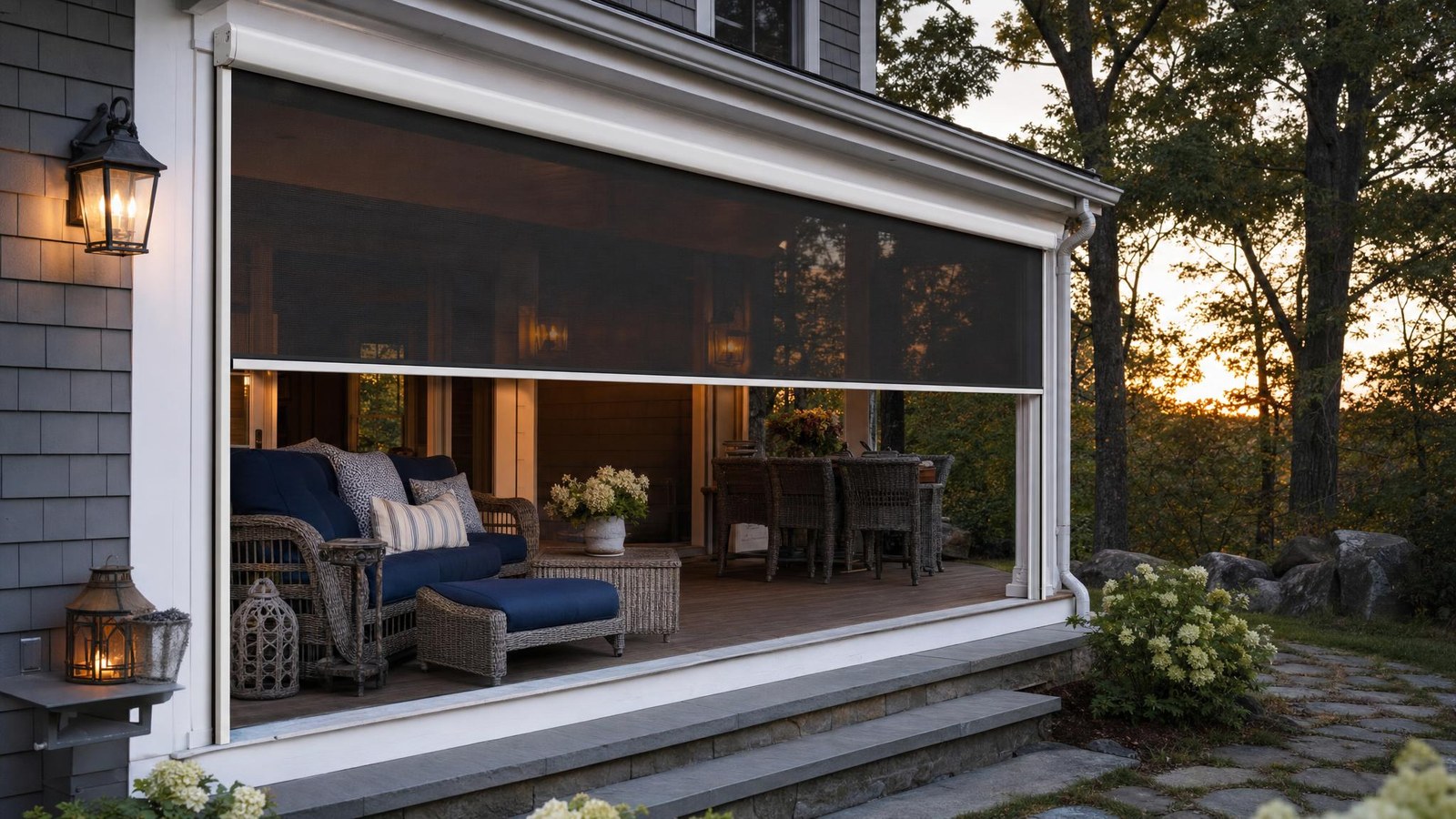
This is a question people rarely ask until a storm takes the power out with the awning extended. With mains-powered motors, no power usually means no motion. Some models have a manual override or emergency crank that lets you retract the unit by hand, and some do not. Ask before you buy, and ask where the crank lives and how it works.
Connecticut sees power outages in winter storms and summer thunderstorms. Ready.gov has practical advice on power outage preparation. For an awning or screen, the plan is simple: retract early when a storm is forecast, rather than waiting for the lights to go out. Our storm prep guide for awnings and screens lays out the routine, and when to retract an awning or screen gives rules of thumb.
Do the remote, sensors and app need power too?
Yes, and they are part of the planning. A few examples:
- Remote controls run on batteries, often a coin cell. Keep spares.
- Wind and sun sensors are available for our screens and an optional wind sensor for our awnings. Some sensors are wired and some are wireless, and either needs a power source of its own or a link to the motor receiver. Where they mount affects how well they work.
- Wall switches are available on some products and need a wiring route.
- Smartphone control and timers are available on some models and depend on a hub or bridge, which usually needs its own plug and a decent wireless signal outside.
Our guide to smart-home integration for motorized awnings covers the control side in more depth, and motorized screens vs retractable awnings explains how the two product types differ.
How should you plan for power before the installer arrives?
- Mark where the unit will mount and identify which end the motor cable exits. Your installer will confirm that at the visit.
- Find the nearest existing outdoor outlet and check that it has a weather-protected cover and GFCI protection.
- Look inside. Is there a room on the other side of the wall with an outlet or panel close by that makes a hardwired run easy?
- Photograph the area including the soffit, siding and any trim that a wire would need to pass.
- Think about switch location. A wall switch near the door is convenient. A remote alone is fine for many owners.
- Ask your insurance agent or HOA if outdoor electrical work requires notice, especially in an association.
What should you ask before you buy?
- What voltage and power source does this exact model use?
- Is it plug-in, hardwired, or both, and where does the cable exit?
- Is a manual override or battery backup available?
- Is a solar or battery option available for this model, and what are the limits in a shaded or snowy location?
- Who handles the electrical connection and permits, and what does it cost?
- What sensors and controls are included, and which are optional?
- What is the plan if the power goes out while it is extended?
When this is the wrong approach: do not buy a motorized unit on the assumption that it will be easy to power. If your home has no practical route for power to the mounting location, say so at the estimate. In some cases a manual option, a different mounting spot or a different product is the better answer, and we would rather tell you than leave you with an unusable unit.
We install across the state, including in Norwich, Groton and Colchester. For a broader look at choices and costs, see the retractable awning buying guide.
Frequently asked questions
How are motorized retractable screens powered?
Our motorized screens use Somfy motors that run on standard household current, with a single low-voltage wire run to the screen cassette. They are operated by wireless remote, with optional wall switches and smartphone control. Details vary by model, so confirm the setup for your specific unit.
Do motorized awnings need to be hardwired?
Not always. Depending on the model and the site, a motor may plug into a protected outdoor outlet or be wired to a junction box or switch. Hardwiring gives a cleaner look but needs a licensed electrician. Ask which arrangement your model uses and who will do the work.
Do I need an electrician to install a motorized awning or screen?
If a suitable, protected outlet or junction box is already in the right spot, you might not. If you need a new outlet, a new circuit or hardwired wiring, you almost certainly do. Ask at the estimate who handles it, and get the answer in writing.
Are there solar-powered awnings or screens?
Some manufacturers offer solar-assisted or battery options on certain models, but availability varies and our product pages describe household-powered motors. Ask whether a solar option exists for your specific model. Connecticut winters, shade and cold batteries all limit what a small panel can do.
Can I use an extension cord to power my awning?
We do not recommend it for permanent use. Cords outdoors are exposed to damage from foot traffic, lawn tools, snow and sun. If the only option is a cord, plan on adding a proper weather-protected outlet instead. An electrician can advise on code and placement.
What happens to a motorized awning in a power outage?
With a mains-powered motor, no power typically means no movement. Some models include a manual override or emergency crank, and some do not. Ask before buying, and retract the awning early when a storm is forecast rather than waiting for the power to fail.
Do wind sensors need their own power?
Often yes. Some sensors are wired and some are wireless, and either needs a power source or a link to the motor receiver. Placement affects performance. A wind sensor is a backup, not a substitute for retracting the unit yourself before strong wind.
Can I add power to an existing pergola for screens?
Often yes, but a freestanding pergola may need a new outlet or a wire run through a conduit from the house, which usually means an electrician. Check local code and any association rules first. Our pergola and gazebo guide lists what else to confirm about the structure.
Not sure how your awning or screen would be powered?
Tom Magnoli will look at the mounting spot, the nearest power and your options, and tell you honestly what the job will need, at no cost for the estimate.
Or call (860) 510-3862