
Storm Season Guide · Connecticut Shoreline
Awning Storm Prep in Connecticut: Hurricanes, Nor’easters and Your Retractable Awnings and Screens
Good awning storm prep Connecticut homeowners can rely on comes down to one rule: retract early and treat the product as fair-weather equipment. Here is what to do before a hurricane or nor’easter, and what is honestly out of any awning’s control.
In this guide
- The honest truth about awnings and storms
- Awning storm prep Connecticut homeowners should know before the watch
- Your storm prep timeline
- Awnings, screens and shades: what differs in a storm
- Automation helps, but it is not a storm plan
- When an awning is not the right product for a storm-prone spot
- Frequently asked questions
- Get your awning ready for the next storm season
The honest truth about awnings and storms
We install retractable awnings, screens and shades, and we say this at every estimate: none of them are storm protection. A retractable awning is a lightweight, engineered system meant to shade a patio and shed light rain. When a hurricane or a hard nor’easter is on the way, its job is to be rolled up and out of the wind.
The cassette helps. When an awning is fully retracted, the fabric and arms sit inside a housing instead of out in the air. That is why a retracted awning survives a lot of weather that would shred an extended one. But the cassette is a shield, not a promise, and a long, strong storm can still stress the wall mounting, the housing and anything attached to them.
The same goes for our motorized retractable screens. They are rated for moderate wind, and the optional wind sensors help on ordinary gusty days. Our screens page says plainly that we recommend retracting during severe weather, and so do we here.
Awning storm prep Connecticut homeowners should know before the watch
Connecticut gets two kinds of big coastal storms. Tropical systems and hurricanes bring very strong winds and storm surge, usually from late summer into fall. Nor’easters bring sustained winds, heavy rain or snow and coastal flooding, and they can hit any time from fall through spring. The Hurricane of 1938 is still the New England benchmark, and more recent storms keep the risk in mind.
The National Weather Service sorts the warning stages clearly. According to its hurricane watch and warning guidance, a hurricane means sustained winds of 74 mph or more and a tropical storm means 39 to 73 mph. Watches are issued about 48 hours before tropical-storm-force winds are expected, and warnings about 36 hours ahead. Treat the watch as your cue to prepare the outdoor gear.
It is also worth knowing your own flood zone. A study cited by Connecticut Sea Grant found that about 70 percent of coastal Connecticut residents were unsure whether their home is in an evacuation zone. The Coastal Storm Preparedness Story Map is a free way to check, and it is not about awnings at all, which is the point: protect the house first and the shade second.
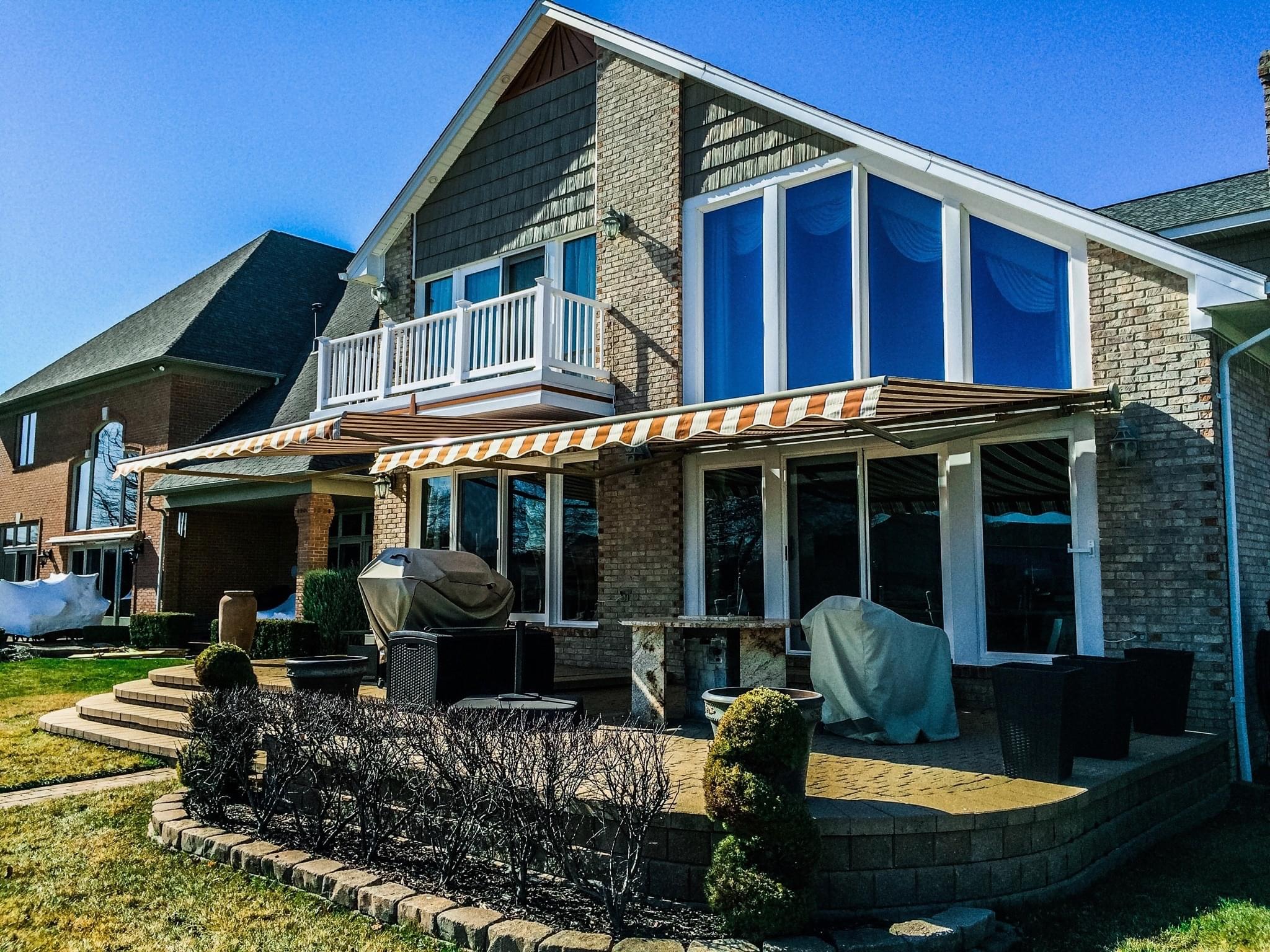
An extended awning is shade equipment. Roll it up well before a storm arrives.
Your storm prep timeline
For general guidance on preparing your home, Ready.gov advises bringing in outside furniture and clearing drains and gutters. We would add your awning and screens to that list.
Want a firm number for your home?
Awnings, screens and shades: what differs in a storm
| Product | What to do | Honest limit |
|---|---|---|
| Retractable awning | Retract fully into the cassette at a watch | Large projecting arms and fabric catch wind if left out |
| Retractable screen | Roll into the housing before storms | Rated for moderate wind, not storm gusts |
| Exterior solar shade | Raise before strong wind | Not impact protection for glass |
If you want a windbreak on a breezy patio, our post on windbreak screens in Connecticut explains what a screen can and cannot do. It is for everyday wind, not storms.
Automation helps, but it is not a storm plan
An optional wind sensor retracts the awning automatically when wind speeds rise past a safe level, and some models support timers and smartphone control. That is a real convenience, and it is why we recommend it on exposed lots. But sensors depend on power, the correct settings and a working motor. A long storm can take out power and a timer can be set to extend the awning at the wrong moment.
Before a storm, retract by hand or remote and turn off schedules. Read our guide to smart-home awning integration for how to set up automation sensibly, and winterize your retractable awning for cold-season care that overlaps with nor’easter prep.
When an awning is not the right product for a storm-prone spot
If the spot is directly on the water, open to the full fetch of the Sound, and you want it usable in strong wind, a retractable awning or screen may disappoint. Those are fair-weather products. A fixed structure designed for the load, such as an engineered pergola, may suit better, though it brings its own permit and structural considerations.
If you cannot or will not retract before storms, or the home is vacant for long stretches during storm season, an awning is a poor fit unless someone can look after it. We would rather tell you that than sell you something that will be damaged.
For shoreline homes that do suit awnings, we use powder-coated aluminum frames and cassette housings. See our coastal pages for Old Saybrook and Groton, and our installation guide for how mounting is done.
Frequently asked questions
Are retractable awnings and screens hurricane-rated?
No. Retractable awnings and screens are built to be extended in normal weather and retracted when it turns bad. They are not storm shutters or hurricane protection. We recommend retracting during heavy storms and high winds, and the screens are rated for moderate wind only.
When should I retract my awning before a storm?
Do it as soon as a storm is a real possibility, not when the first gust hits. The National Weather Service issues hurricane watches about 48 hours before tropical-storm-force winds are expected and warnings about 36 hours ahead, so a watch is a sensible time to retract and lock down.
Will the wind sensor protect my awning in a hurricane?
It is a safeguard for ordinary gusty days, not a storm plan. A sensor needs power and correct settings to work, and a long storm can cut both. Retract by hand or by remote early and treat the sensor as a backup.
What if the power goes out and my awning is open?
Our motors run on household current, so a power loss can leave an extended awning stuck out. Ask us about the manual override on your specific model during installation, and retract early so you are not relying on it.
Should I take my awning down for a major hurricane?
For a direct hit from a strong storm, that is a fair question to ask us before the season, not during it. Retracted into its cassette, the unit is protected from most of the fabric exposure, but we will not claim it is guaranteed to survive an extreme storm. Ask about your own mounting and exposure.
What should I check after a storm?
Look at the fabric, frame and wall mounting for loose fasteners, bent arms or tears before you try to operate it. If something looks off, do not run the motor. Call us for repair and see our repair and replacement guide.
Get your awning ready for the next storm season
Tom Magnoli can look at your mounting, test your controls and talk through a storm plan that fits your home. Free estimates, with an apples to apples price match guarantee on the same specs.
Or call (860) 510-3862