
Coastal Connecticut · Maintenance and Specification
Salt Air Awnings in Coastal Connecticut: What Actually Holds Up
Salt does not ruin a good awning. Neglect and the wrong details do. Here is how salt air treats fabric, frames, fasteners and motors, and what a shoreline homeowner should specify and do.
If you live on the Connecticut shoreline, you have probably noticed what salt does: the railings pit, the grill rusts, the car needs washing after a storm. It is reasonable to wonder what it will do to a motorized awning or screen that hangs on the same wall. This guide covers salt air awnings in coastal Connecticut as we see them, from Fairfield County to Stonington, drawing on Tom Magnoli’s 12 years in the industry.
The short version: a quality awning built from the right materials does fine on the shore. Problems tend to come from salt and grime sitting on the surface for months, from mismatched hardware, and from leaving an awning out when it should have been retracted. All three are avoidable.
In this guide
- What salt air actually does to an awning
- Fabric: the part people worry about, and the easiest to protect
- Frame, arms and fasteners: where coastal installations differ
- Motors, controls and sensors near the water
- A simple shoreline care routine
- Where we see salt-air problems go wrong
- Screens and exterior shades in salt air
- Salt air awnings and screens: frequently asked questions
- Want an awning built for the shore?
What salt air actually does to an awning
Salt arrives as fine spray and as dry crystals carried on the wind. It lands on everything. Two things make it a problem. First, salt holds moisture, so surfaces that would dry quickly after a rain stay damp longer, which helps mildew on fabric and corrosion on metal. Second, salt in contact with metal, especially where two different metals touch, speeds up corrosion.
What it does not do is melt a well-made awning overnight. The components fail in different ways and at different speeds, which is why it helps to take them one by one.
| Component | What salt air tends to do | What helps |
|---|---|---|
| Fabric | Salt and dirt hold moisture and feed mildew | Solution-dyed acrylic, regular rinsing, drying before long retraction |
| Frame and arms | Chips or scratches in the finish let corrosion start | Powder-coated aluminum, quick touch-up, fresh-water rinse |
| Fasteners | Mixed metals corrode where they meet | Matching, corrosion-resistant hardware chosen for the wall |
| Motor and wiring | Moisture and salt in connections cause faults | Protected connections, correct installation, periodic checks |
| Wind sensor | Exposed sensors collect salt and grime | Occasional wipe-down and test |
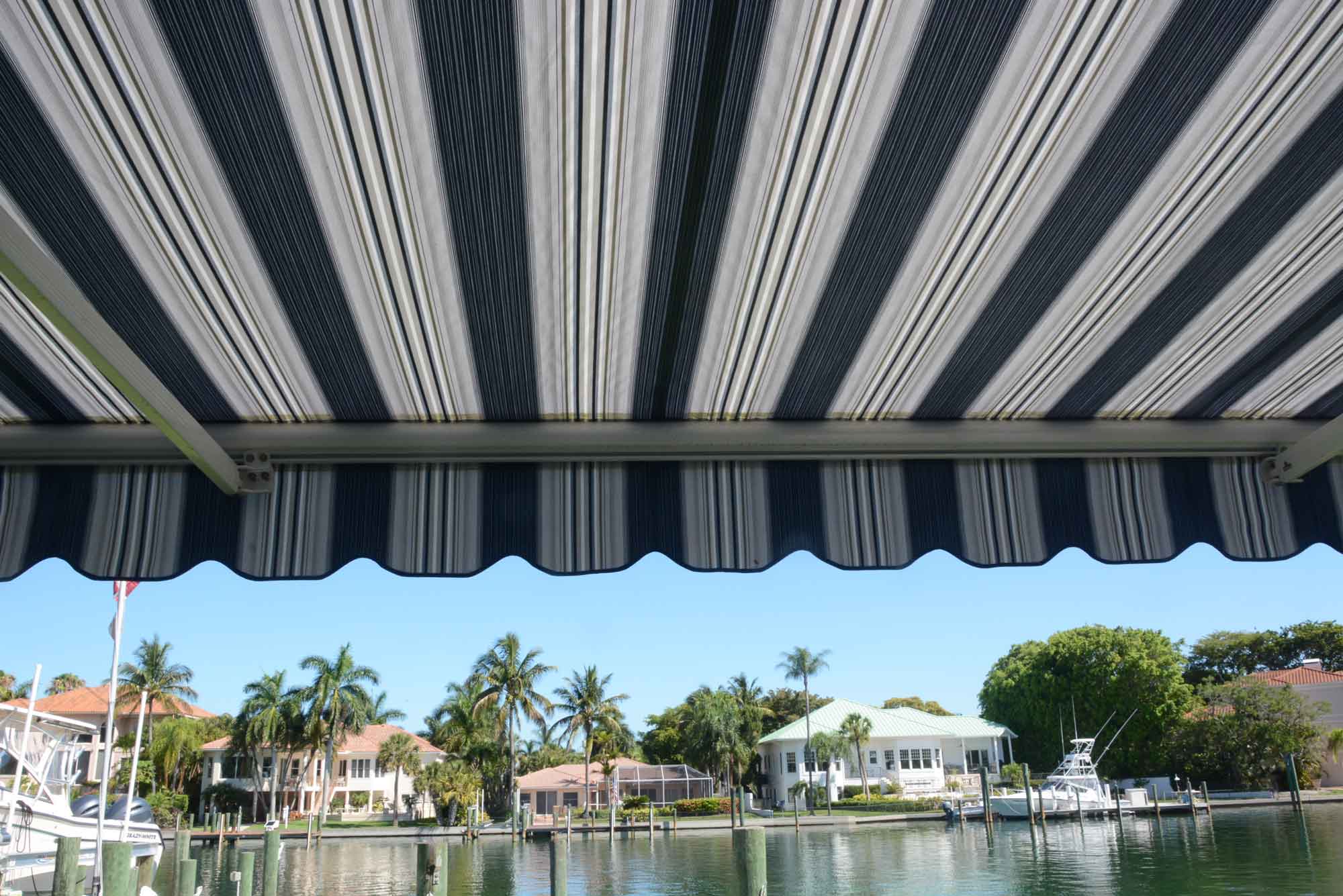
Waterfront homes get the best views and the most salt. Specification and care matter more here.
Fabric: the part people worry about, and the easiest to protect
Our awnings use Sunbrella solution-dyed acrylic fabric. Solution-dyed means the color goes through the entire fiber rather than sitting on the surface, which is why it resists fading far better than a printed or surface-dyed fabric. Salt does not bleach it.
What fabric does need is cleaning. Sunbrella’s published guidance is simple: brush off dirt and debris before it embeds, clean with a mild soap solution in lukewarm water using a soft brush or sponge, rinse thoroughly to remove soap residue, and let the fabric air dry. You can read their full recommendations in the Sunbrella care and cleaning guide. Avoid pressure washers, hard bristles and abrasive scrubbing.
On the shoreline, the habit that makes the biggest difference is rinsing salt off before it dries into the weave and before you retract a damp awning for a long stretch. Our Sunbrella awning maintenance guide covers the routine in more detail.
Frame, arms and fasteners: where coastal installations differ
Our awnings use powder-coated aluminum frames and a cassette housing that protects the fabric and arms when retracted. A cassette is a real advantage near the water, because the working parts are enclosed rather than sitting in the weather all winter.
Aluminum does not rust the way steel does, but its coating can be chipped, and where that happens salt will find the bare metal. The Aluminum Association’s Care of Aluminum publication covers cleaning methods for painted and anodized aluminum finishes. For a homeowner, the practical rule is to rinse the frame with fresh water when you rinse the fabric, wash off any salt film, and touch up chips early.
Want a firm number for your home?
Motors, controls and sensors near the water
Our motorized awnings use Somfy or DOOYA motors with a wireless remote, and a wind sensor is available as an option. On the coast, the sensor deserves more attention than people give it. Wind is the single biggest threat to any retractable product, and the Sound can deliver gusts quickly when a front or a storm moves through. An automatic sensor is a useful backup if you are not home, but it does not replace retracting the awning yourself when the forecast turns.
Keep the sensor clean, test it a couple of times a season, and keep the remote batteries fresh. If a motor or control ever acts up, get it looked at early. Our repair and replacement guide explains what is worth fixing and what is not.
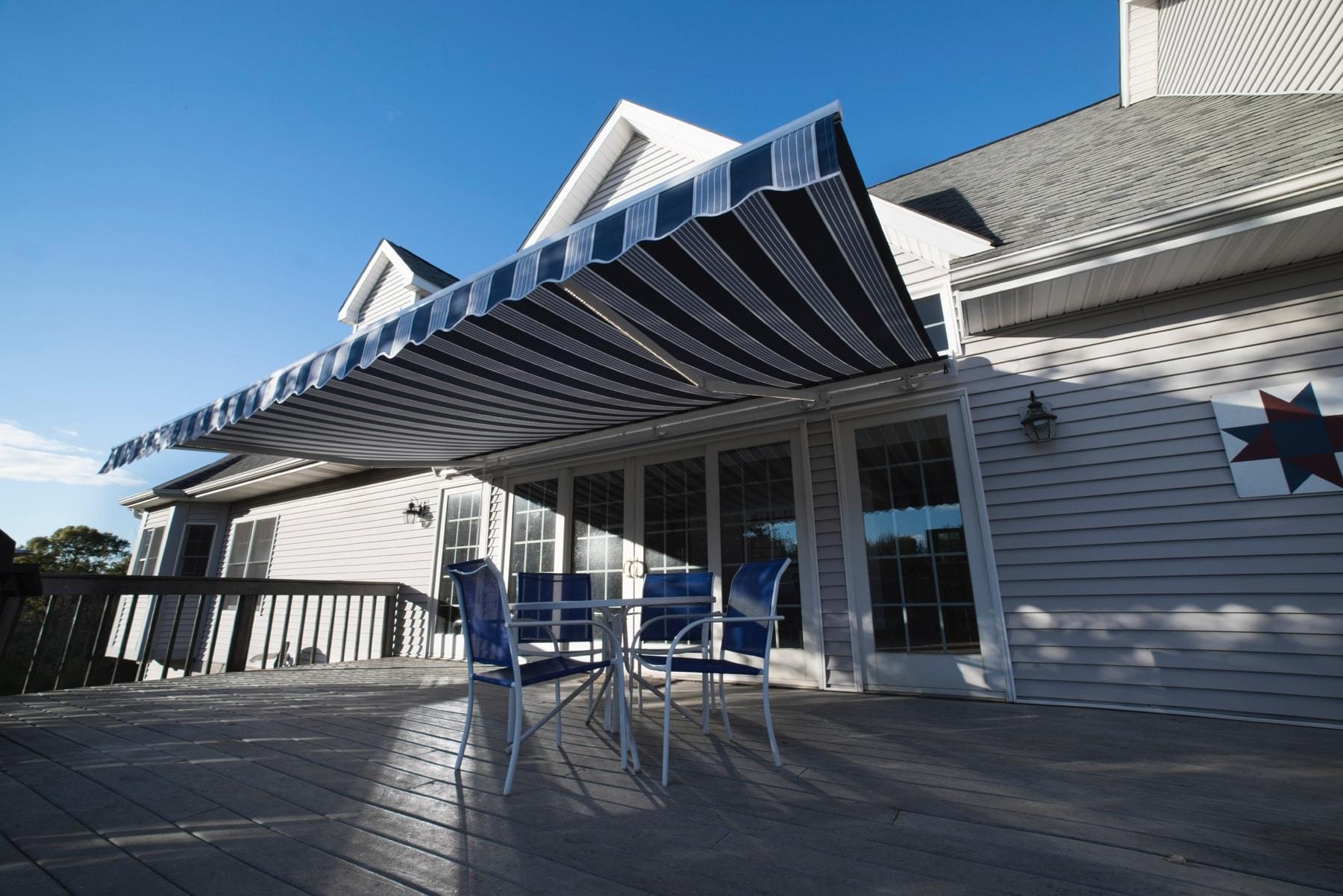
A retractable awning on a rear deck. Regular rinsing keeps the fabric and frame in good shape.
A simple shoreline care routine
Where we see salt-air problems go wrong
Most of the issues we hear about trace back to a short list. A homeowner never rinsed the awning for several summers. An awning was left open in a storm. A cheap kit with mixed-metal hardware was bolted to a wall. Or a chip in the finish was never touched up. None of these is exotic. This is also why our retractable awning cost guide makes the point that a lower price often reflects a lower specification, and that matters most on the water.
If you want local examples of coastal installations, our town pages for Old Saybrook, Madison and Clinton describe how we approach shoreline homes in those towns.
When this is not the right product: a retractable awning is not meant to stay open in a storm, and no product that rolls up is a substitute for a fixed structure. If your property takes direct, constant wind off open water, a screen or awning may spend a lot of time retracted. In that case we would talk with you about windbreak screens or a different shade solution rather than promise more than the product can do.
Screens and exterior shades in salt air
The same principles apply to our motorized retractable screens: rinse them, keep the housing clean, and retract them in strong wind. Mesh can accumulate salt and dust that reduces visibility and airflow, so a gentle rinse is worthwhile. If glare rather than rain is your main problem, our exterior solar shades are another option. For awnings, see our retractable awning page.
Salt air awnings and screens: frequently asked questions
How far inland does salt air affect an awning in Connecticut?
There is no single distance. Salt exposure is heaviest at the water and on Sound-facing walls, and it fades with distance, tree cover and the direction of your prevailing storms. A house on a marsh, river mouth or open point can see more salt than one a few blocks back. We look at the exposure of the actual wall when we measure.
Is Sunbrella fabric safe in salt air?
Sunbrella is solution-dyed acrylic, which means the color runs through the fiber, so it resists fading and holds up outdoors. Salt does not ruin the fabric, but salt and dirt left on it can feed mildew, so a regular fresh-water rinse still matters.
How often should I rinse my awning if I live on the shoreline?
A gentle fresh-water rinse of the frame and fabric every month or two in the warm season is a sensible habit, and after any storm that threw spray at the house. Brush off loose debris first, and use mild soap if the fabric is dirty. Our Sunbrella maintenance guide has the detail.
Will salt air void my warranty?
Warranty terms depend on the product and the manufacturer, so we do not summarize them here. Ask for the written warranty at your estimate and check what it says about coastal exposure and care requirements before you decide.
Should I leave the awning out during a coastal storm?
No. Retractable awnings and screens are built to be retracted when wind picks up. Optional wind sensors can retract an awning automatically, but they are a backup, not a reason to leave it open. Retract it before a storm and treat it like outdoor furniture.
Do I need a different product if I live on the water?
Not necessarily a different product, but a more careful specification. We pay attention to the frame finish, hardware, motor and sensor options and the mounting. Where the exposure is severe, we will tell you honestly if another product, or a fixed one, would serve you better.
Want an awning built for the shore?
We will measure, look at the exposure of your wall and recommend a specification that fits. Every quote is backed by our apples to apples price match guarantee.
Or call (860) 510-3862