
Weather · Wind · Rain · Snow · Ice
When Should You Retract an Awning or Screen? Rain, Wind, Snow and Ice Rules for Connecticut
Plain-language rules of thumb for when to roll up a retractable awning, screen or exterior shade in Connecticut weather, from everyday gusts to thunderstorms and winter ice.
Short answerRetract before the weather arrives: in heavy rain, in gusty wind once small trees are swaying (roughly 19 to 24 mph), before any thunderstorm, and for the whole cold season when snow and ice are possible. Light, steady rain with calm air is usually fine for an awning. When you leave home and the forecast is doubtful, retract. These are rules of thumb, and your manual and wind-sensor settings take priority.
Last updated: October 2026. Written by the Shoreline Shade team in Clinton, CT.
In this guide
- What are the simple rules for when to retract an awning or screen?
- How windy is too windy?
- Can you leave an awning or screen out in the rain?
- What should you do before a thunderstorm?
- What about snow and ice?
- Do the rules differ by product?
- Can a wind sensor retract the unit for you?
- What is a simple routine so you never forget?
- When do these rules not apply?
- Frequently asked questions
- Want a setup that is easier to protect?
What are the simple rules for when to retract an awning or screen?
Retract before the weather arrives, not after. The simplest working rules for Connecticut are these: retract in heavy rain, retract when the wind is gusting enough to move small trees, retract before any thunderstorm, and keep both retracted in snow and ice. When you leave the house for the day or the weekend and the forecast is questionable, retract then too. Every one of those rules comes from the same idea: fabric and mesh are safe when they are rolled up inside a housing and exposed when they are out.
These are rules of thumb, not engineering ratings. Your manual and the settings on any wind sensor come first, and the details differ by product. Our retractable awnings are designed to give rain protection when extended, but we recommend retracting them during heavy storms or high winds. Our motorized retractable screens are rated for moderate wind, with optional sensors that retract them automatically when wind becomes unsafe, and we recommend retracting during severe weather.
How windy is too windy?
Wind is the condition that causes most awning and screen damage, and it is the hardest to judge by feel. Forecasts give a sustained speed and a higher gust speed. Gusts are what hit the fabric, so use the gust number. A practical way to judge without an instrument is the Beaufort scale, which links wind speed to things you can see. The National Weather Service explains it on its Beaufort wind scale page.
| What you see | Approximate wind | Our rule of thumb |
|---|---|---|
| Leaves and small twigs in constant motion | About 8 to 12 mph | Fine to use. Stay aware and watch the forecast. |
| Dust and loose paper lift, small branches move | About 13 to 18 mph | Use with attention. Do not leave an awning out if you are leaving the house. |
| Small leafy trees sway | About 19 to 24 mph | Retract awnings. Retract screens too, unless your manual and sensor say otherwise. |
| Large branches move, wires whistle | About 25 to 31 mph | Everything retracted. No exceptions. |
| Whole trees sway, walking is hard | 32 mph and up | Retracted and, if applicable, secured. Check for damage afterward. |
Wind speeds are the standard Beaufort scale ranges. The rule-of-thumb column is our conservative guidance, not a manufacturer rating. Your product’s manual and wind-sensor setting take priority.
Direction matters too. Wind blowing straight into the open front of an awning lifts it like a wing. Wind from behind, across the housing, is less dangerous but still stresses arms and brackets. A gusty day with swirling wind around a building can be worse than a steady breeze of the same speed. For the physics of how wind moves around structures, see our windbreak screens guide.
Can you leave an awning or screen out in the rain?
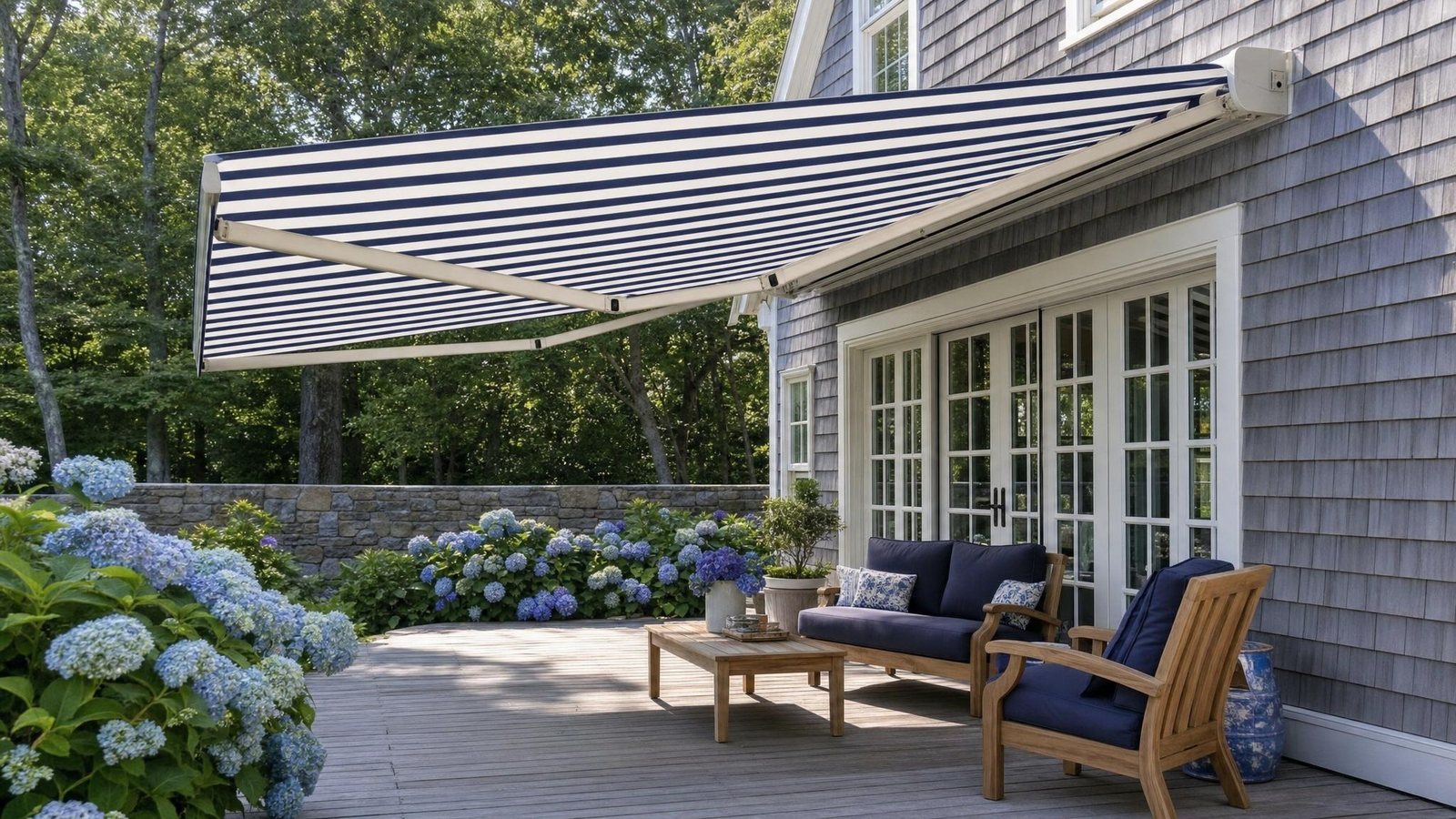
Light rain with little wind is usually fine for an awning, which is designed to give rain protection when extended. Our Sunbrella awning fabric is treated with a water-repellent finish. The risk grows with the amount of water and the amount of wind. Here is how we think about it:
- Light, steady rain, calm air: an awning is doing its job. Keep an eye on the front edge for water running off rather than pooling.
- Heavy downpour: retract. A lot of water collects quickly, and pooled water is heavy and stretches fabric.
- Rain with gusting wind: retract. This is the combination that causes damage.
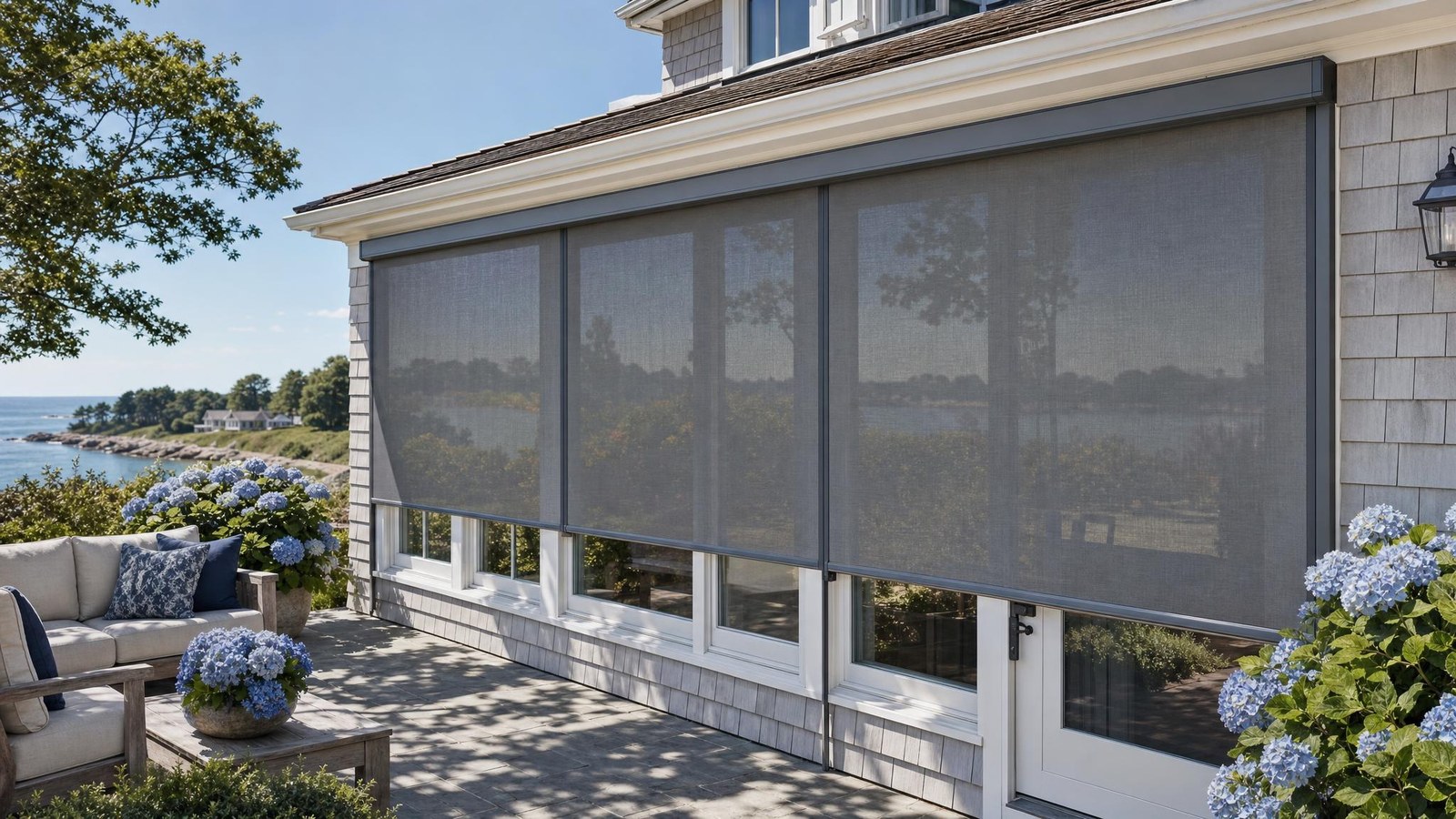
- Screens in rain: mesh passes water, so a light rain is not a problem on its own, but wind-driven rain and debris are. Retract in severe weather.
What if you retract wet fabric?
If you must retract a wet awning, plan to extend it again in dry weather within a day or two so the fabric dries completely. Damp fabric rolled into a cassette is the easy route to mildew. Our Sunbrella awning maintenance guide covers cleaning and drying.
What does pooling look like?
A low spot or sag in the fabric where water gathers. If you see it, retract the awning and have the pitch checked. A pitch that is too shallow is a setup issue, not a weather issue.
What should you do before a thunderstorm?
Retract at the first credible warning, which means a severe thunderstorm watch or warning, a darkening sky with distant thunder, or a forecast that includes strong storms. Thunderstorms bring sudden gusts well before the rain starts, and the strongest wind often arrives with little warning. The National Weather Service’s thunderstorm safety guidance makes the key point: when thunder roars, go indoors. Do not walk out to a patio to wrestle with an awning during lightning.
That is a strong argument for motorized units. If you can retract with a remote from inside the house, you can do it early and safely. If your awning is manual, plan to retract earlier than you think you need to. Our storm prep guide for awnings and screens goes through tropical storms, nor’easters and what to do afterward. If you want automation to help, see smart-home integration for motorized awnings.
What about snow and ice?
Keep awnings and screens retracted from the first hard freeze to the end of the cold season, and never extend or retract a unit that is frozen, iced over or loaded with snow. Wet snow is heavy, ice locks parts together, and a motor forced against frozen fabric or a frozen track can be damaged. If a unit is iced in the extended position, do not chip at it with tools. Wait for a thaw or call for help.
- Before the first freeze: retract, dry and secure everything. Our winterizing guide walks through it.
- After a storm: look for snow or ice that has slid off the roof onto a housing, and for dents or bent bottom bars.
- On mild winter days: resist the urge to extend to enjoy a sunny afternoon unless the unit is fully clear and above freezing, and the manual allows it.
- In spring: use our spring checklist for awnings and screens before the first operation.
The National Weather Service has background on what to expect during winter storms. Connecticut gets all of it: heavy snow inland, freezing rain in between, and coastal wind. Treat the unit as a fair-weather product for the whole season.
Want a firm number for your home?
Do the rules differ by product?
A little. This summary is general, and your manual rules.
| Condition | Retractable awning | Motorized screen | Exterior solar shade |
|---|---|---|---|
| Light rain, calm | Usually fine extended | Fine; mesh passes water | Usually fine |
| Heavy rain | Retract | Retract if wind or debris | Retract if wind or debris |
| Gusty wind | Retract early | Retract; check the sensor setting | Retract; guides help but are not a storm barrier |
| Thunderstorm | Retract before it arrives | Retract before it arrives | Retract before it arrives |
| Snow or ice | Keep retracted | Keep retracted | Keep retracted |
| Away from home | Retract if there is any doubt | Retract if there is any doubt | Retract if there is any doubt |
Can a wind sensor retract the unit for you?
An optional wind sensor can retract an awning or screen automatically when wind exceeds a setting. It is a good safety net, particularly for the weekday when nobody is home. It is not a substitute for you, for a few reasons. It can only react to wind it senses at its location. It can fail, lose power or be set too high. It cannot see a thunderstorm coming. And a sensor cannot protect a unit that is iced or already damaged.
If you have one, test it each spring, ask your installer what the sensitivity is set to, and ask what the unit does if power is lost. Settings and behavior vary by model. Our power guide, how motorized awnings and screens are powered, covers outages, and the motorized screens vs retractable awnings comparison explains how the two product types handle weather differently.
What is a simple routine so you never forget?
- Check the forecast each morning during the season, looking at gusts and storm chances rather than only the temperature.
- Retract when you leave the house if there is any doubt, even for an hour.
- Retract at bedtime if wind or storms are in the overnight forecast.
- Keep the remote where you can reach it, and keep a spare battery.
- Look at the unit after every storm before you extend it again.
- Retract fully for the season before the first hard freeze.
Coastal towns like Stonington, Old Saybrook and East Lyme get stronger sustained wind off the water than most inland yards, so the thresholds above are even more important there. For salt and moisture issues, read salt air and coastal awnings and screens.
When do these rules not apply?
No rule of thumb replaces your manual, your installer’s advice, or good judgment about the specific conditions at your house. A unit mounted high on a windy hillside, on a corner lot, or near a coastal point sees different wind than the same unit in a sheltered backyard. Older units, damaged units and units with unusual mounting can be less tolerant. If you are unsure whether a given day is safe, retract it. Rolling up a perfectly good awning on a day that turns out fine costs you a few minutes of shade. Leaving it out on the wrong day can cost far more.
If you have questions about your own unit, call us at (860) 510-3862 or send a note. For choosing a product with weather in mind, see the retractable awning buying guide.
Frequently asked questions
What wind speed is too high for a retractable awning?
There is no single number, because ratings vary by model. As a conservative rule of thumb, retract when small trees are swaying, roughly 19 to 24 mph on the Beaufort scale, and always retract in stronger wind. Gusts matter more than average speed. Your manual and wind-sensor setting take priority.
Can I leave my retractable awning out in the rain?
Light, steady rain with calm air is usually fine, since awning fabric is designed to give rain protection and is treated with a water-repellent finish. Retract in heavy downpours, in rain with gusty wind, and in storms. Retract any time water is pooling or the fabric is sagging.
Should I retract my awning before a thunderstorm?
Yes, as early as you can. Thunderstorms often bring sudden strong gusts before the rain arrives. The National Weather Service advises going indoors when thunder is heard, so retract from inside with a remote if you have a motorized unit, rather than going out during lightning.
Can I use a retractable awning or screen in winter?
We advise keeping them retracted through the cold season. Snow is heavy, ice locks parts together, and forcing a frozen unit can damage the motor, arms or fabric. Never operate a unit that is iced or loaded with snow. Wait for a thaw, and follow a proper winterizing routine.
What if my awning is frozen or covered in snow?
Do not run the motor and do not chip at it with tools. Wait for a thaw so the ice releases naturally, then inspect before operating. If it is damaged or stuck, call a professional. Forcing a frozen awning can bend arms, tear fabric and strip gears.
Do retractable screens need to be retracted in rain?
Mesh passes water, so light rain alone is not usually a problem. Wind-driven rain, debris and storms are. Our screens are rated for moderate wind, and we recommend retracting them during severe weather. A wind sensor can retract them automatically, but it is a backup rather than a replacement for your judgment.
Will a wind sensor protect my awning while I am away?
It can help, but it is not a guarantee. A sensor reacts only to wind at its location, may be set too high, and depends on power and function. It cannot anticipate a thunderstorm. If you are leaving for a day or longer and the forecast is uncertain, retract the unit yourself.
How do I dry an awning that was retracted wet?
Extend it again on the next dry, breezy day and let the fabric dry completely, then retract. Damp fabric left rolled up in a cassette is the usual cause of mildew. If you notice spots, a gentle wash with mild soap and a thorough rinse usually helps, as in our maintenance guide.
Want a setup that is easier to protect?
Tom Magnoli can talk through sensors, remote control and placement so your awning or screen is simple to retract when weather turns, at no cost for the estimate.
Or call (860) 510-3862