
Three-Season Rooms · Screened Porches · Retractable Screens
Can You Add Retractable Screens to a Three-Season Room or Screened Porch in Connecticut?
If you already have a porch or a three-season room, retractable screens can add sun control, privacy and wind relief that fixed screens cannot. They can also be the wrong move. Here is how to tell, and what the install involves.
Short answer: Yes. Motorized retractable screens can be added to most three-season rooms, screened porches and covered porches that have a solid header or ceiling to mount to and posts to run the side tracks along. They can screen the open sides, add a sun or privacy layer over existing fixed screens or glass, or replace tired screen panels. They are not insulation, they are not a storm shutter, and they do not turn a three-season room into a heated room.
By Shoreline Shade, LLC, Clinton, Connecticut · Last updated October 2026
In this guide
- What is the difference between a three-season room and a screened porch?
- Why add retractable screens to a porch that already has screens?
- Four ways retractable screens go onto a porch or three-season room
- What does your porch need for retractable screens?
- What about power and controls?
- Which mesh should you choose for a porch?
- Can retractable screens stay up in winter or in storms?
- Do you need a permit or approval?
- What drives the cost of adding retractable screens?
- When retractable screens are the wrong choice for a porch
- Frequently asked questions
- Find out if your porch can take retractable screens
What is the difference between a three-season room and a screened porch?
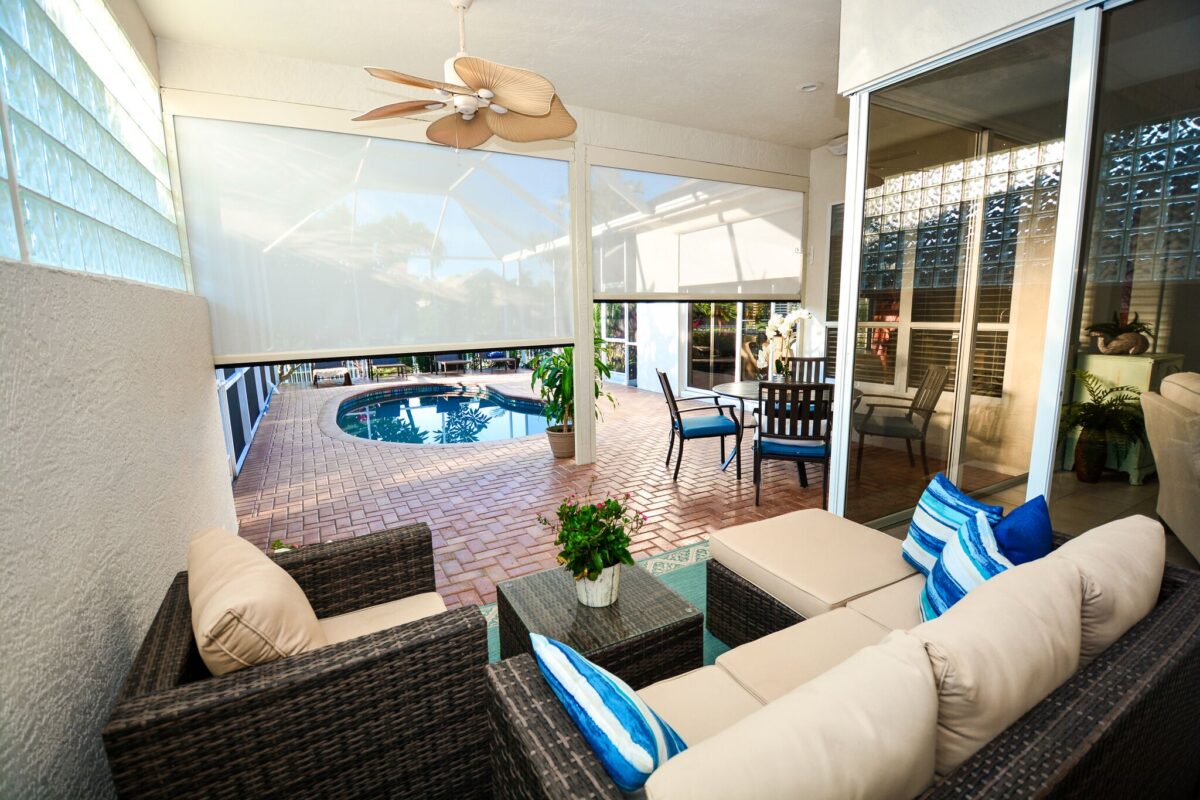
The words get mixed up, so here is how we use them. A screened porch is a porch with screens in fixed frames, often wood or aluminum, across its open sides. A three-season room is usually an enclosed room with windows, often glass or vinyl, but without full insulation or heating. A covered porch has a roof and open sides, with nothing in the openings yet.
All three can take a retractable screen. What changes is where it goes and what it does. On a covered porch, the screens are the enclosure. On a screened porch, they are a second layer. On a three-season room, they usually go on the outside of the glass to reduce solar heat before it gets into the room.
In every case, the term “three-season” is an honest limit. These are spaces for spring, summer and fall. A retractable screen does not insulate and does not turn the space into winter living space.
Why add retractable screens to a porch that already has screens?
If your fixed screens are in good shape and all you want is bug protection, you may not need anything else. Retractable screens earn their place when you want something fixed screens cannot do.
- Sun and glare control. Fixed insect screen blocks insects, not much sun. A solar mesh on a retractable screen blocks up to 97% of UV according to our product page, cuts glare and keeps a view out.
- Daytime privacy. Privacy mesh gives a close lot some separation by day without turning the porch into a box.
- Wind relief. Heavier wind mesh can reduce gusts, in our product page’s words, by up to 65%.
- An open-air option. When the screen is retracted, the opening is clear. Fixed screens are always there, which cuts the view and the light a little.
- Worn or damaged screens. If your fixed screens are torn, sagging or rusty, replacing them with retractable screens can be a better use of money than re-screening.
If your porch mostly has mosquito problems, start with our guide to mosquito protection with retractable screens. The state’s Mosquito Management Program also reminds homeowners to remove standing water around the house, which a screen cannot do for you. For a deeper comparison with permanent enclosures, read screen rooms vs retractable screens.
Four ways retractable screens go onto a porch or three-season room
| Situation | What we usually do | Why it works |
|---|---|---|
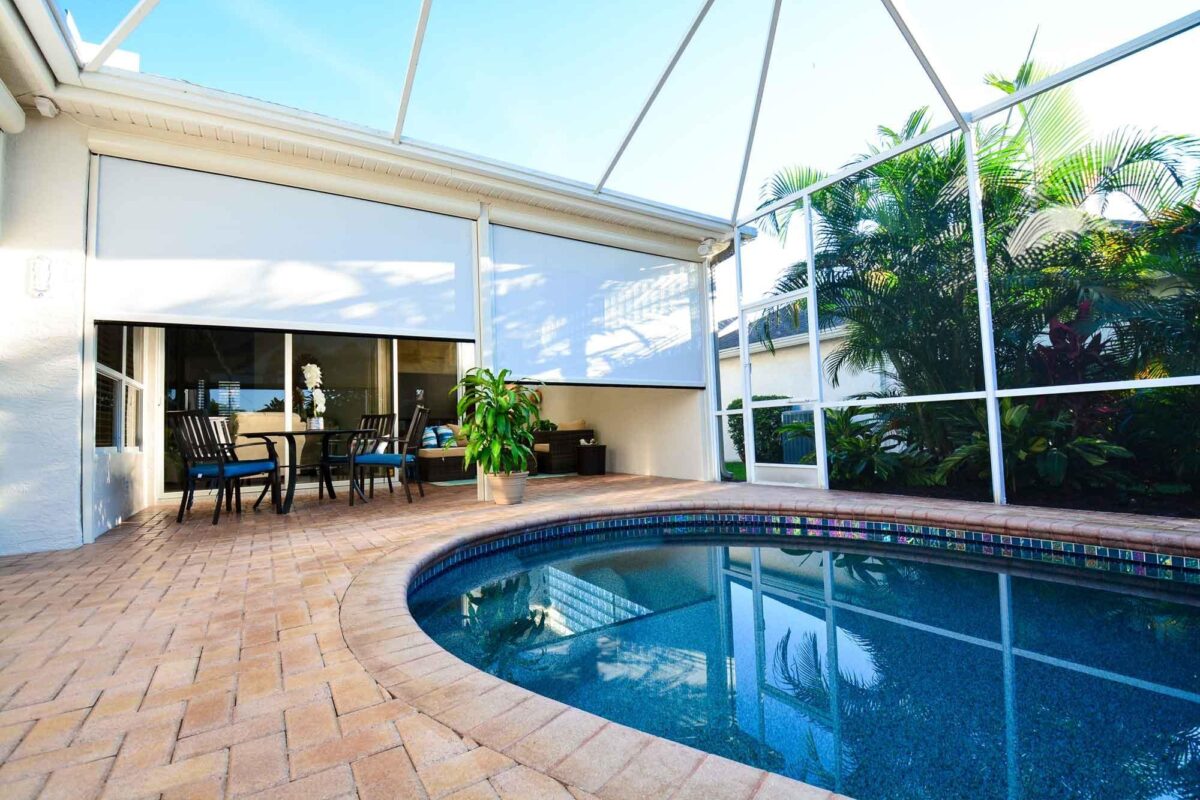
| Open covered porch | Screens span each open side, mounted at the header or between posts | The retractable screens are the enclosure, with no frame to build |
| Existing fixed screens in good shape | Add a retractable screen outside the fixed screen as a sun, wind or privacy layer | Keeps the bug screen, adds control on demand |
| Worn fixed screens | Remove the old panels and mount retractable screens in the opening | New enclosure without re-screening |
| Three-season room with glass or vinyl windows | Mount screens outside the glass, on the exterior wall or overhang, in solar mesh | Blocks sun before it reaches the glass, so the room is easier to use in summer |
The best choice depends on the structure. At the estimate we look at what you have and what you want, and sometimes we recommend doing less. See our porch shades guide and motorized porch screens guide for how these combine with other products.
What does your porch need for retractable screens?
A retractable screen is a motor-driven roller in a housing (the cassette) with a track on each side. That means three things have to be right.
- A solid place for the cassette. The housing needs a structural header, beam, soffit or ceiling above the opening. A sagging or rotted header has to be fixed first.
- Side tracks on solid vertical members. Posts, columns or the wall on each side. If the posts are out of plumb, the installer has to allow for that. Older porches are often not square, which is one reason we measure each opening, not the whole porch.
- A bottom landing. The screen needs a floor, sill or rail to meet at the bottom. An uneven deck, a step or a railing changes the details.
Our product page lists three mounting methods. In the order we see them most:
| Mount | How it looks | Best for |
|---|---|---|
| Surface mount | Cassette on the face of the header, soffit or wall | The most common and versatile method |
| Between posts or columns | Screen fits between existing structural posts | Covered patios, porches and pergolas |
| Recessed (flush mount) | Cassette hidden in the ceiling or header | New construction or remodels, where it can be built in |
The widest single unit on our product page is 25 feet. For a wider opening, multiple units run side by side with minimal gaps. We are not the right company to speculate on your specific structure from a photo, so we measure on site.
What about power and controls?
Per our product page, the Somfy motors run on standard household current (110V), and a single low-voltage wire runs to the screen cassette. You operate the screens with a wireless remote, with optional wall switches and optional smartphone control.
In plain terms, you need a convenient outlet near each screen or a way to bring power there. If your porch has no nearby outlet, an electrician may need to add one, which is a separate trade and a separate cost. We flag this at the estimate so there is no surprise.
Wind and sun sensors are available options. They can retract the screens in a gust or lower them when the sun is bright. Our guide to wind and sun sensors explains what they do and what they cannot do. If you want the screens to join a smart-home setup, see our integration guide.
Which mesh should you choose for a porch?
Mesh matters more than most people expect, because the same housing can be a bug screen, a sun screen, a privacy screen or a wind screen depending on the fabric.
| Mesh | What it does (per our product page) | Good for |
|---|---|---|
| Insect mesh (standard) | Blocks about 90% of insects, with the highest visibility and airflow | Bug protection with the best view |
| Solar mesh | Blocks up to 97% of UV, cuts heat and glare, offers daytime privacy | Hot sides of a porch, west-facing openings |
| Privacy mesh | Denser weave that blocks most outside visibility | Close lots and street-facing sides |
| Wind mesh | Heavier mesh designed to reduce wind gusts, up to 65% reduction | Exposed openings and lakeside or hilltop porches |
You do not have to use the same mesh on every side. Many porches use insect mesh toward the yard, solar mesh toward the setting sun and privacy mesh toward a neighbor. Choose the mesh by opening, not for the porch as a whole.
Wondering if your porch can take retractable screens?
Can retractable screens stay up in winter or in storms?
A three-season room is a three-season room for a reason. Our product page rates the screens for moderate wind and recommends retracting them during severe weather. In a nor’easter, a hurricane watch or a snow and ice event, retract them and leave them retracted. See our storm prep guide and winterizing checklist for the routine.
Screens do not insulate. A mesh screen does not hold heat in, and it does not stop cold air from reaching a three-season room. If your goal is a room you can use comfortably in January, you are looking at a different project, with insulation, glazing and heat.
Do you need a permit or approval?
It depends on what you are doing and where. Adding a screen to an existing covered porch is different from building or enclosing a room. Some towns want a permit for changes to a structure, and homeowners’ associations or historic districts often review exterior changes. Check with your local building department before you order. The state’s building code information is the starting point, and our guide to awning and screen permits, HOA and historic rules explains the questions to ask.
What drives the cost of adding retractable screens?
We quote after measuring, so there is no honest number to give here. The things that move the price are the width and height of each opening, how many units you need, the mesh type, the mounting method, any sensors or smart control, any electrical work, and any carpentry needed to make the structure ready. Our motorized screens cost guide explains these variables.
When retractable screens are the wrong choice for a porch
If the porch has structural problems, fix those first. If you want a room that is heated and comfortable all winter, you want a four-season room. If you only need to screen one door, a Mirage retractable door screen may be a simpler and smaller job, and our Mirage door screens page explains it. If you want a storm shutter, a retractable screen is not that. If the porch is exposed to heavy wind and you want it open on a windy day, expect to retract the screens more often than you would like.
Our town pages cover local conditions in Madison, Colchester and New Canaan.
Frequently asked questions
Can you put retractable screens on a three-season room?
Yes, in most cases. The screens usually mount outside the glass or windows, on a solid header or wall, and block sun and bugs when lowered. They do not insulate, so the room stays a three-season space. We measure and check the structure at the estimate before recommending anything.
Can retractable screens replace the fixed screens on my screened porch?
Often yes. If the old panels are torn, sagging or rusty, retractable screens can be mounted in the opening instead. They retract fully for the open view, and you choose the mesh. We check the header, posts and floor line first, since older porches can be out of square.
Do retractable screens need electricity?
Our motorized screens run on standard household current, with a single low-voltage wire to the cassette and a wireless remote. If there is no outlet near the opening, an electrician may need to add one. We flag power at the estimate so you know before you decide.
How wide can a retractable screen be?
On our motorized screens page, a single unit can be up to 25 feet wide. For wider openings, multiple units run side by side with minimal gaps. Height and mounting method also matter, and we confirm both on site.
Will retractable screens block sun as well as bugs?
They can, if you choose the right mesh. Standard insect mesh blocks about 90% of insects and keeps the best view. Solar mesh blocks up to 97% of UV and cuts glare and heat. Privacy and wind meshes serve other needs. You can use different mesh on different sides.
Can retractable screens stay down in winter or a storm?
No. Our screens are rated for moderate wind, and we recommend retracting them in severe weather, including nor’easters, hurricane watches and snow or ice. Wind sensors are available as options, but they are a safety net rather than a storm plan.
Do I need a permit to add retractable screens to my porch?
It depends on your town, the structure and any association rules. Adding a screen to an existing covered porch is different from building or enclosing a room. Check with your local building department and any HOA before you order, and we can supply drawings of what we plan to install.
What if my porch is old or out of square?
That is common and usually workable. We measure each opening separately, find solid structure to mount to, and tell you if carpentry or repair is needed first. If the framing is not sound, we will say so rather than mount a screen to it.
Find out if your porch can take retractable screens
Tom Magnoli will visit, measure each opening, check the structure and the power, and tell you honestly whether retractable screens fit your three-season room or porch, at no cost.
Or call (860) 510-3862 · shorelineshadellc@gmail.com