
Small Spaces · Townhouses · Condos · Balconies
What Shade Works for a Small Deck, Townhouse Patio or Condo Balcony in Connecticut?
Narrow widths, shared walls, association rules and higher wind change the shade question. Here is what fits, what to check first, and when a retractable product is the wrong answer.
Short answerOn a small deck or townhouse patio, motorized retractable screens or an exterior solar shade usually fit more easily than an awning, which starts at 10 feet wide. On a condo balcony, the answer begins with your association: the railing, ceiling and facade are often not yours to drill, so get written approval before you order anything. If nothing can be attached, a freestanding or removable option is the honest alternative.
Last updated: October 2026. Written by the Shoreline Shade team in Clinton, CT.
In this guide
- What kind of shade works for a small deck, townhouse patio or condo balcony?
- How do the options compare by type of space?
- Who owns the balcony or patio, and who has to approve changes?
- What should you submit to the board?
- What are the mounting limits on a small deck, patio or balcony?
- Will a retractable awning even fit a small space?
- How does wind change things on an upper-floor balcony?
- How do you handle sun, heat and privacy in a small space?
- What drives cost for a small project?
- When is a retractable product the wrong choice?
- What are good next steps?
- Frequently asked questions
- Wondering what fits your space?
What kind of shade works for a small deck, townhouse patio or condo balcony?
For a small space, the best shade is the one you can actually get approved, mount and operate in the room you have. On a small private deck attached to a house, a retractable awning or exterior solar shade is often possible. On a townhouse patio, retractable screens or a solar shade may fit where an awning does not. On a condo balcony, the answer starts with your association, because you may not own the walls, ceiling or railing you would mount to.
Smaller spaces create their own constraints: narrow widths, low ceilings, shared walls, higher wind at upper levels, and rules written by someone other than you. This guide walks through each, and it is honest about the cases where the best answer is not one of our products. Shoreline Shade sells SunPro retractable awnings, SunPro motorized retractable screens, Mirage retractable door screens and exterior solar shades, and nothing else.
How do the options compare by type of space?
| Space | Typical constraints | Options to consider |
|---|---|---|
| Small private deck on a single-family house | Narrow width, nearby windows, house wall as the mount | Retractable awning if the width suits, motorized screens for bugs and wind, exterior solar shade for glare |
| Townhouse patio or deck | Shared walls, association exterior rules, limited mounting surface | Screens between posts or on the face of a header, a solar shade, or a narrow awning if approved |
| Ground-floor condo patio | Patio may be a limited common element; the building wall belongs to the association | Approval first; then screens, shade or awning as allowed |
| Upper-floor condo balcony | Railing, ceiling and facade often association property; higher wind; fire and safety rules | Possibly motorized screens or solar shade if approved; often a removable solution is the only option |
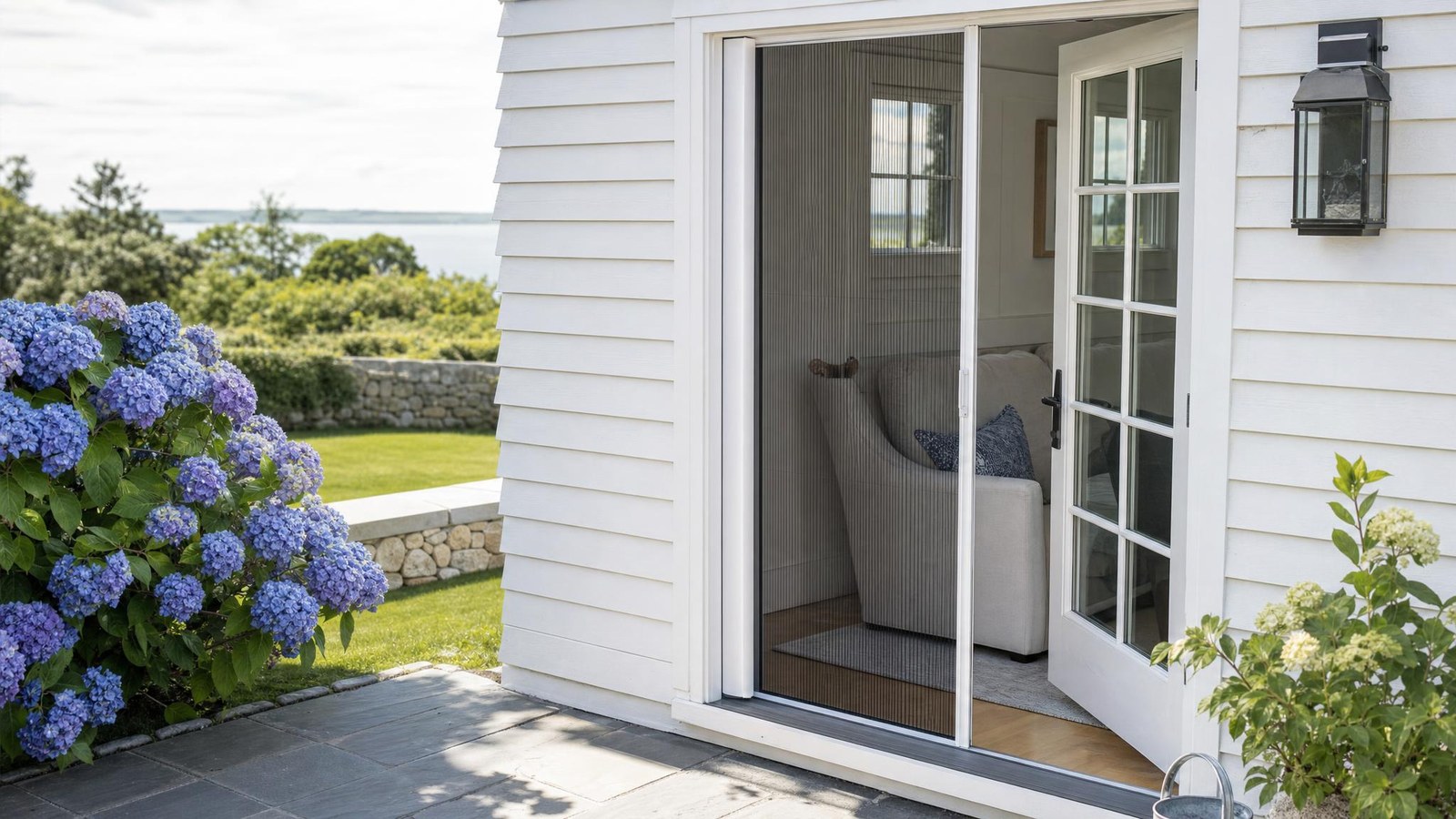
| Slider onto any of the above | Bugs when the door is open | Mirage retractable door screen |
General guidance. Your documents and your building decide what is allowed.
Who owns the balcony or patio, and who has to approve changes?
Ask this first. In many condominiums, the balcony or patio is a “limited common element,” meaning you have exclusive use of it but the association owns or controls the structure. The facade, railing, ceiling above and floor below may belong to the association even when the space feels like yours. In townhouse communities, exterior walls, roofs and decks are often regulated by architectural guidelines, whether or not you own the land under them.
Connecticut’s Common Interest Ownership Act (Chapter 828 of the General Statutes) is the main state law for many condominiums and associations, and older condominiums may fall under an earlier act. We are not lawyers and we cannot tell you which applies to your building. Your association’s manager or attorney can. What we can say is that nearly every association has written rules about exterior changes, and the safe order is approval first, order second.
What to read before you ask
- The declaration, bylaws and rules and regulations, especially any section on balconies, patios, awnings or exterior alterations.
- Architectural guidelines, which often specify colors, materials and allowed products.
- Any prior approvals the board has granted to neighbors. These are useful precedents.
- Insurance requirements. Some associations ask for proof of coverage for exterior work.
What should you submit to the board?
A complete package gets faster, cleaner decisions. Include:
- A photo of the space showing where the unit would mount.
- The product type, size, color and fabric or mesh choice.
- A description of how and where it attaches, and what it attaches to.
- Photos or catalog pages of the product. Ask us for the product details your board will want, and tell us what you need so we can say what we can provide.
- Who will install it and when.
- Your agreement to maintain it, fix any damage and remove it if the association requires.
Our guide to awning and screen permits and HOA rules in Connecticut covers the broader approval process, and the State Building Code questions are handled by your local building official under the Office of the State Building Inspector‘s framework. Ask both your association and your town, because an association approval does not replace a permit where one is required.
What are the mounting limits on a small deck, patio or balcony?
Everything retractable needs something solid to attach to. The questions that decide it:
- What is the wall made of? Wood framing, brick, block, stucco and vinyl-clad walls each need different fasteners and different care to avoid water getting in. Foam-backed stucco systems and thin veneers can be poor anchoring surfaces.
- Is there solid framing behind it? A housing needs to anchor into structural members, not just siding. Thin or hollow walls may need added blocking.
- Is the surface yours to drill? On a condo balcony, penetrating the facade or ceiling may be prohibited outright, or may need the association’s own contractor.
- What is above you? The underside of the balcony above, a soffit or a low ceiling limits the space for a cassette.
- Will it block anything? Windows that open, egress paths, light fixtures and gas or electric meters must stay accessible.
- Is the railing structural? Railings are not designed to carry awning loads, and some are life-safety components. Never attach a motorized unit to a railing without approval and an engineering answer.
When a space cannot take an attachment, the honest answer may be a freestanding or removable solution that is not something we sell. We would rather say so than force an installation that fails or violates your rules.
Want a firm number for your home?
Will a retractable awning even fit a small space?
Possibly not. Our retractable awnings are offered from 10 to 40 feet wide, with projection up to 12 feet. A small townhouse deck that is 10 to 12 feet wide may suit a single awning, but a narrow balcony does not. If your space is under about 10 feet across, an awning is likely not the right tool, and we will tell you that at the estimate rather than stretch a product to fit.
Projection matters as much as width. A deck 8 feet deep needs enough projection to put shade on the seating at the sun angles you care about, but not so much that the awning dips into view or bumps the railing. The sun is high in summer and low in fall and spring, so one setting rarely does everything.
Screens and shades are often better fits for small spaces
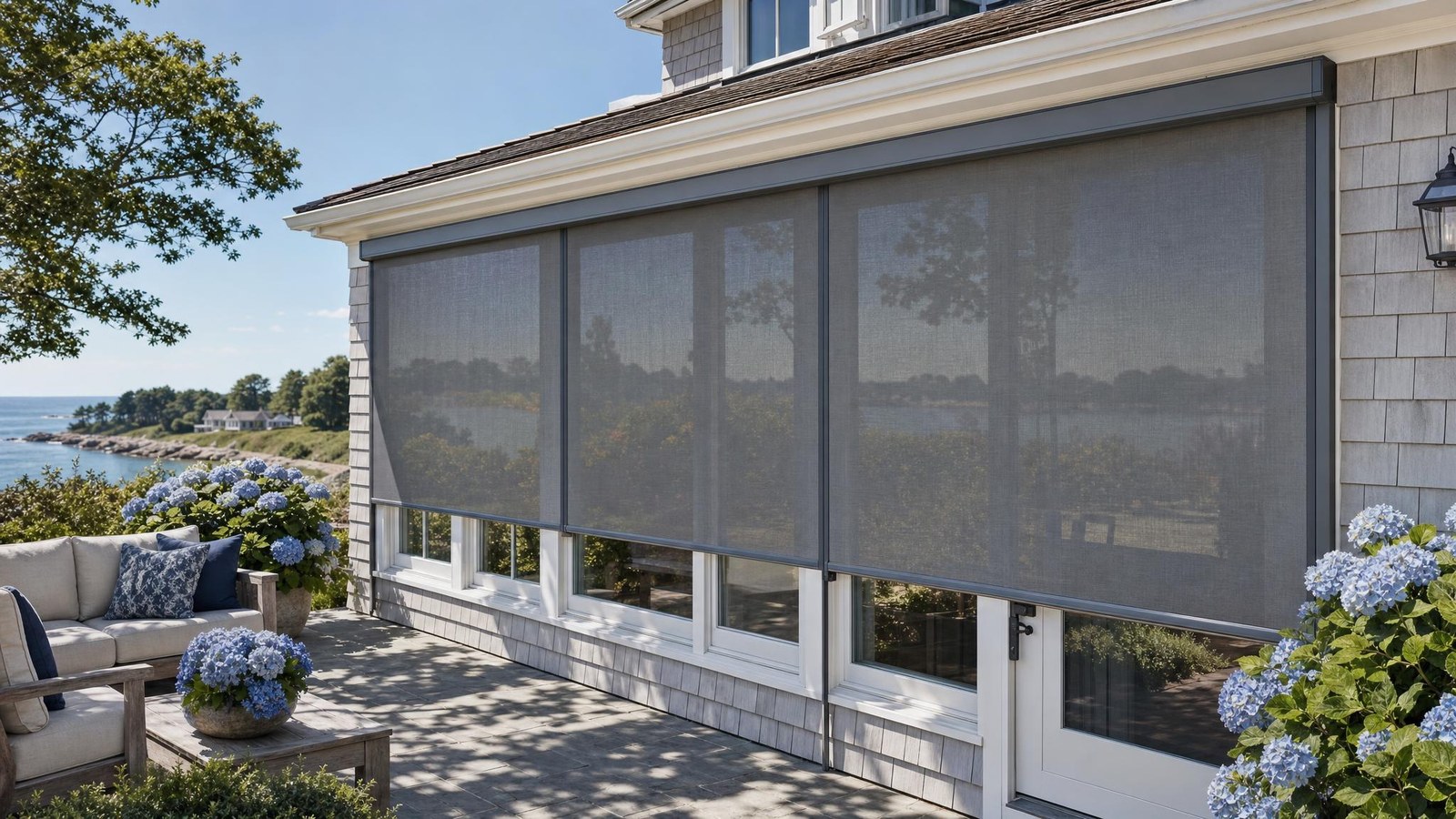
- Motorized retractable screens are available up to 25 feet wide per unit, in insect, solar, privacy and wind mesh. They can serve patios, porches and balconies. See motorized retractable screens.
- Exterior solar shades reduce heat, glare and UV before it reaches the glass and keep an outward view. Fabrics come in different openness levels. See exterior solar shades and our comparison of solar shades vs retractable screens.
- Mirage door screens cover sliders and French doors up to 16 feet wide and disappear when not in use. See Mirage retractable door screens.
How does wind change things on an upper-floor balcony?
Wind speeds up with height, and the corners and faces of buildings create gusts and eddies. A balcony on the third floor of a building near the shore can see much more wind than a ground-level patio nearby. Our screens are rated for moderate wind, and an optional wind sensor can retract them automatically. Heavier wind mesh reduces gusts by up to 65%. None of that makes a screen a storm barrier, and nothing hanging off a high balcony should ever be left out in strong wind. Falling hardware or a torn-away unit is a safety issue for people below, as well as a repair bill.
Plan to retract early, as described in when to retract an awning or screen, and read the National Weather Service’s plain-language wind safety material. If you will be away for long stretches, a unit that nobody can retract is a poor idea on a high balcony. Our windbreak screens guide explains why porous mesh often handles wind better than solid barriers.
How do you handle sun, heat and privacy in a small space?
Start with which way the space faces. West-facing balconies catch hot late sun, and a retractable awning is hard to make work for low western sun. A solar mesh screen or solar shade on the west side often does more. South-facing spaces get high sun that an awning or overhead balcony handles well. East-facing spaces are usually comfortable by afternoon, and bugs or privacy may matter more.
Privacy is a bigger deal in a townhouse or condo, where neighbors are close. Privacy mesh gives daytime obscurity while passing light and air, though it is less effective at night when your lights are on. Insect mesh keeps the best view and airflow. For ideas specific to decks and porches, see retractable deck screens and porch shades in Connecticut.
What drives cost for a small project?
Small does not always mean cheap. A custom-made unit still needs a motor, hardware, fabric or mesh, and an installer’s time, and some of that does not shrink with the opening. The main drivers:
- Product type and size, including width, drop or projection.
- Mesh or fabric choice, and any sensor or control add-ons.
- Wall material and how much preparation the mounting needs.
- Power access, and whether an electrician must add an outlet or wiring. See how motorized awnings and screens are powered.
- Any documents, drawings or insurance your association requires.
We quote after measuring, and our awning cost guide explains the awning side in more detail.
When is a retractable product the wrong choice?
If your association prohibits exterior attachments, if you rent and cannot alter the building, if the surface cannot be drilled safely, if the space is narrower than the smallest product, or if nobody will be there to retract the unit in weather, a retractable awning or screen is the wrong tool. A good outdoor umbrella, a removable shade, plants or a freestanding screen may do the job better. Those are not products we sell, and we will say so at the estimate.
If you are on the fence, get the approval question answered first. It is the cheapest step and it saves you from buying something you cannot install.
What are good next steps?
- Read your association documents and ask the manager what applies to your space.
- Photograph the space and measure the opening width and ceiling height.
- Ask for a free estimate so we can tell you which products fit and what the mounting will involve.
- Submit your request to the board, with the product details you need.
- Order only after approval, and schedule installation to avoid conflicts with building rules or quiet hours.
We serve all of Connecticut, including condo and townhouse communities in towns like Darien, West Hartford and North Haven. See all of our retractable screens or call (860) 510-3862.
Frequently asked questions
Can I put an awning on a condo balcony in Connecticut?
Only if your association allows it and the building can take the attachment. In many condos the facade, ceiling and railing belong to the association, so approval comes first. Also check the awning’s minimum width, since our awnings start at 10 feet wide and many balconies are narrower.
What kind of shade works best on a small townhouse patio?
Motorized retractable screens or an exterior solar shade often fit better than an awning because they can mount between posts or on a header and come in many widths. A narrow awning may work if your association approves it. The right choice depends on sun direction, mounting surface and rules.
Do I need HOA or condo board approval for retractable screens?
Almost certainly, if you live in an association. Most have written rules for exterior changes, including screens, shades and awnings. Read your declaration and architectural guidelines, ask the manager, and submit product details and mounting information before you order. A permit from your town may also be needed.
Can I attach a shade to a balcony railing?
We would not do it without association approval and an engineering answer. Railings are often life-safety components that are not designed to carry awning or screen loads. If the railing is your only option, a removable or freestanding solution may be a safer choice than a permanent attachment.
Will retractable screens work on a high-floor balcony?
They can, if approved and securely mounted, but wind is stronger at height. Our screens are rated for moderate wind, with optional wind sensors and heavier wind mesh. They are not storm barriers, and anything on a high balcony should be retracted early in strong wind.
What is the smallest awning you offer?
Our retractable awnings are offered from 10 to 40 feet wide with projection up to 12 feet. If your space is narrower than about 10 feet, an awning is likely not a fit. Screens or exterior solar shades may be better. We will tell you honestly at the estimate.
Can a Mirage screen door go on a condo slider?
Often yes. Mirage retractable door screens fit sliding glass doors, French doors and single entry doors, up to 16 feet wide for sliders. Because it mounts at the door frame, it can be a gentler change, but you should still check whether your association regulates exterior door modifications.
What if my condo does not allow attachments?
Then a retractable awning or screen may not be possible, and we would rather say so than sell you something you cannot install. A freestanding umbrella, a removable shade or plantings may be the right answer. Ask your board whether any exceptions or approved products exist.
Wondering what fits your space?
Tom Magnoli will measure your deck, patio or balcony, look at the mounting surface and tell you honestly which product fits and what your association may ask for, at no cost for the estimate.
Or call (860) 510-3862