
Solar Shades vs Retractable Screens in Connecticut: Which One Does Your Porch Need?
Shade & Awning Guides · Connecticut
Solar Shades vs Retractable Screens in Connecticut: Which One Does Your Porch Need?
Solar shades vs retractable screens is a question we answer at nearly every estimate, because the two products look alike and solve different problems. Here is a plain guide to choosing between them for a Connecticut porch, patio or deck.
In this guide
Solar shades vs retractable screens: the short answer
Both products are vertical, motorized and roll up into a slim housing. That is where the similarity ends. A solar shade is a sun-control product. It is made to cut heat, glare and UV before they reach your glass or your seating. A retractable screen is an insect-and-wind product that can also block sun, depending on the mesh you pick.
So the cleanest way to decide is to ask what is wrong with the space right now. If the problem is a west-facing wall that bakes every afternoon, you want a shade. If the problem is mosquitoes at dusk, you want a screen. If it is both, there is a middle path, which we cover below. Our product pages describe each in detail: exterior solar shades and retractable screens.
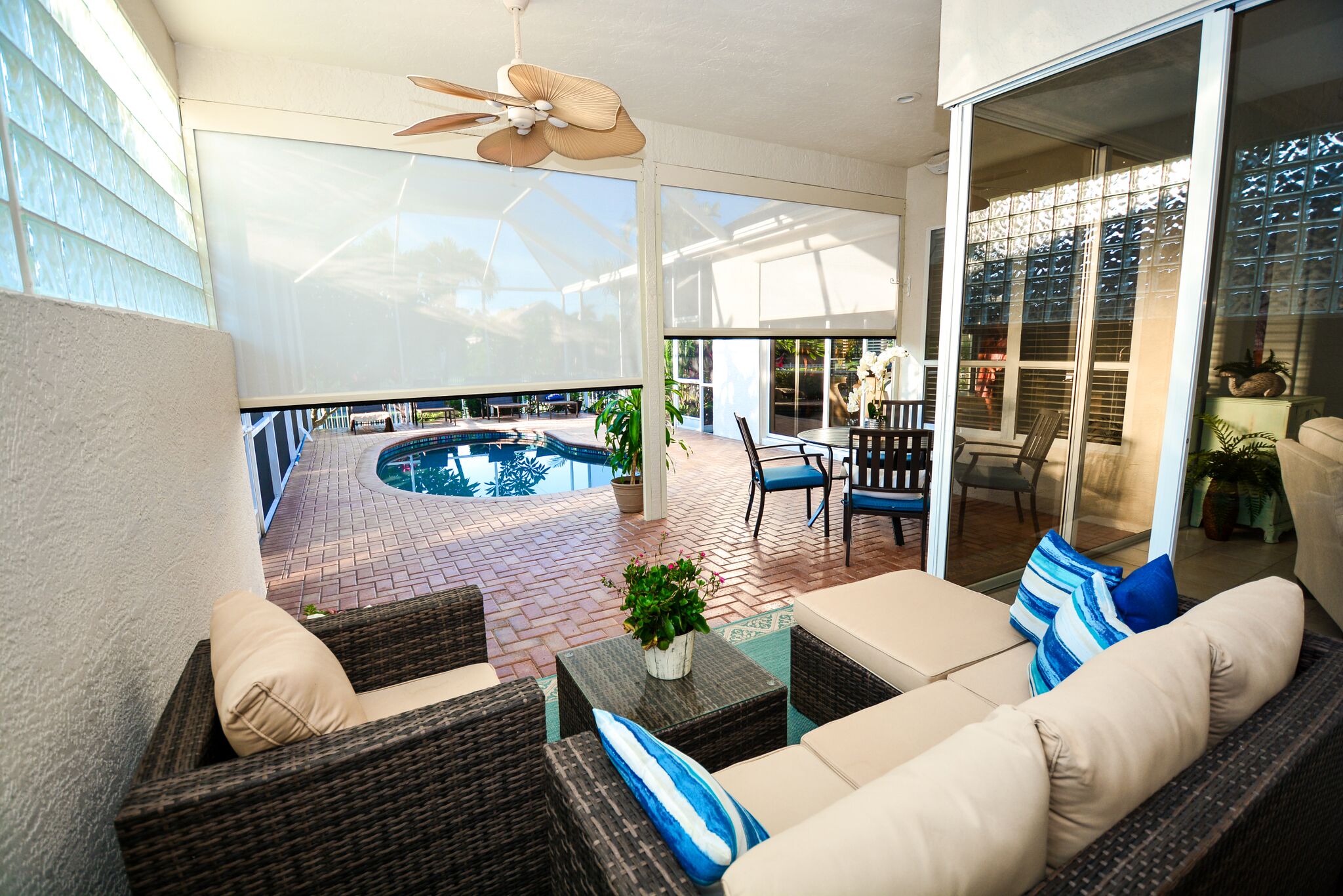
Vertical shades and screens on a covered patio: the hardware looks similar, but the fabric decides the job.
What each product actually does
The US Department of Energy notes that window attachments, including exterior products, can cut summer solar heat gain by as much as 60 percent. See its page on window attachments for the general science. The point is that stopping the sun outside the glass works better than managing it after it is already in the room.
Side-by-side comparison
| Solar shade | Retractable screen | |
|---|---|---|
| Primary job | Heat, glare and UV control | Insects, wind, UV and privacy (by mesh) |
| Insect protection | Not what it is sold for | Yes, about 90% with insect mesh |
| UV block | About 90 to 97% by openness | Up to 97% with solar mesh |
| View | Preserved, slightly softened | Depends on mesh |
| Wind | Retract in storms | Rated for moderate wind, wind mesh available |
| Needs something to mount to | Yes | Yes |
| Best on | Sun-baked, glass-heavy openings | Buggy or breezy porches and decks |
Start with your biggest complaint
The afternoon sun is unbearable
Choose a solar shade. Pick the openness by how much view you want to keep: 1% for maximum block and privacy, 3% for a balanced view and 5% when you want the most visibility and airflow. Our guide to exterior solar shades in Connecticut explains how openness and color interact.
Mosquitoes keep you inside after sunset
Choose a retractable screen with insect mesh. The Connecticut Agricultural Experiment Station tracks West Nile virus in mosquitoes each season, and the state’s Mosquito Management Program shares prevention tips. A screen protects the place you sit. Read more in our post on mosquito protection with retractable screens.
You want both sun and bug control
A solar-mesh screen is the compromise. It blocks up to 97 percent of UV and cuts glare while still giving an insect barrier. If the sun is still the bigger problem once you have seen samples, a shade on the sunny side may be the better call, and a screen on the buggy side.
Wind is the issue
Wind mesh on a retractable screen can reduce gusts by up to 65 percent. See our windbreak screens guide. Remember that neither product is a storm barrier.
When neither is the right product
We would rather tell you than sell you the wrong thing. A vertical shade or screen is not the answer if:
- Your deck has nothing overhead to mount to. A retractable awning can attach to the house wall and give overhead cover.
- You want rain protection. Screens and shades do not shed rain the way an awning does.
- You want a heated, sealed room. That is a construction project; see our comparison of screen rooms vs retractable screens.
If you are comparing overhead cover with vertical screening, our post on motorized screens vs retractable awnings walks through that decision.
Want a firm number for your home?
What this costs
Retractable screens in Connecticut typically run from about $800 to $3,000 for a single door or small opening, about $2,500 to $7,000 for a large porch or patio opening, and $8,000 to $20,000 or more for a full multi-bay enclosure. Solar shade pricing depends on size, fabric and mounting, so we quote after measuring. Our screen cost guide breaks down each factor.
Compare like for like. If you collect more than one quote, make sure the products, fabrics and mounting match. We offer an apples to apples price match guarantee when the specifications are the same.
Connecticut-specific notes
Inland and coastal homes face different problems. Hilltop towns such as Ridgefield get wind and wooded-lot insects, which is why screens with wind mesh are popular on our Ridgefield, CT retractable screens page. Coastal and water-view homes often care most about glare and keeping the view, which is the shade conversation. Our exterior solar shades in East Lyme page shows that side.
Fairfield County properties with architectural review or association rules may need approval for visible exterior changes, and both products are easier to discuss than permanent additions because they retract. Check with your town or association before ordering.
Common questions
Are solar shades or retractable screens better for blocking heat?
Solar shades, as a rule. Exterior solar shades are built specifically for heat and glare control, and our shade fabrics reduce solar heat gain by up to 80 percent depending on the openness you choose. A solar-mesh retractable screen also blocks up to 97 percent of UV and cuts glare, but its job is broader: insects, wind and sun together. If heat is your number one complaint, start with a shade.
Which is better for mosquitoes, a solar shade or a retractable screen?
A retractable screen. Our standard insect mesh blocks about 90 percent of insects while keeping good airflow and visibility. We do not sell solar shades as an insect barrier, so if bugs are the main reason you are staying indoors, choose screens.
Can I use solar mesh in a retractable screen?
Yes. Solar mesh is one of the four mesh types we offer for motorized screens, alongside insect, privacy and wind mesh. It blocks up to 97 percent of UV, reduces heat and glare, and gives some daytime privacy. It is a sensible compromise when a porch has both sun and bug problems.
Do solar shades or retractable screens need an overhead structure?
Both mount to something, usually a header, soffit, beam, column or the wall above an opening. A covered porch or pergola is the easy case. A completely open deck with nothing overhead gives a vertical product nothing to hang from, and a retractable awning or a freestanding structure is usually the better starting point.
How windy is too windy for each product?
Neither is a storm product. Our screens are rated for moderate wind, with optional wind sensors that retract them when gusts become unsafe, and a heavier wind mesh is available. Shades should also be retracted in storms. Tell us about your exposure at the estimate so we can match the product to it.
How do I know which one fits my house?
Look at your biggest complaint first, then at what you can mount to. We measure for free, bring samples and give an honest recommendation, including telling you when a different product is a better fit. Call (860) 510-3862 or request an estimate online.
Not sure which product your porch needs?
Tell us what is bothering you about the space, and we will measure, show you samples and recommend the product that fits, even when that is not the one you asked about. We back every quote with an apples to apples price match guarantee.
Prefer to talk? Call (860) 510-3862.